Tag Archives: Three by Five

Introducing Poet Linda Simone

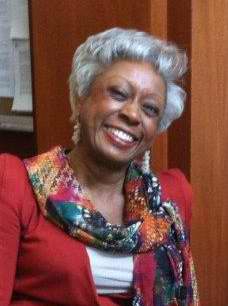
Three by Five presents Poet Linda Simone –

Linda Simone is a poet who also writes essay and is working on a novel in the Southern Gothic tradition. Her essays have appeared in Cezanne’s Carrot, Italian Americana, Journal of the Imagination in Language Learning, The Journal News, The New York Times, and on Purse Stories. Valparaiso Review published her review of poet Kevin Pilkington’s work. Find her poems in numerous journals including Assisi, Cyclamens and Swords.  Her work is in a number of anthologies, including: the award-winning, Cradle Songs: An Anthology of Poems on Motherhood; Lavanderia; and Wait a Minute: I Have to Take Off My Bra. Her chapbook, Cow Tippers, won the Shadow Poetry Chapbook Competition. Linda’s 15-poem sequence, “The Stations of the Cross,” was nominated for a Pushcart Prize by Martin Willitts, Jr., editor of the 2007 anthology, Alternatives to Surrender. The anthology included works by 61 poets from around the globe, dealing with cancer, survival from cancer, death from cancer, and with loss and recovery. Linda and her husband live in New York City.


Linda on the web:

Twitter. ‎ Facebook.  LinkedIn.  


Linda reads her poem Grapefruit  as part o fAlimentum’s Menupoems 2010:

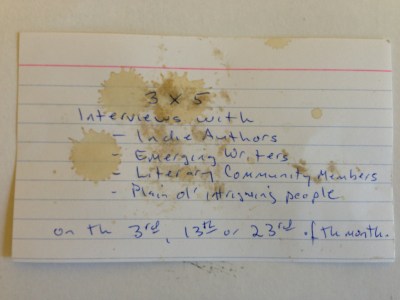
Linda Simone on Three by Five in the month of September on the 3rd, 13th, 23rd and 30th.

3 Comments

Filed under writing life

Three by Five and Jerome Joseph Gentes Part II

VAH: Welcome back to Three by Five and Part II with Jerome Joseph Gentes. edited photo1

Jerome, you talked about your first story earlier and a poem and story “sealing your fate” in college. Would you expand a bit on when you knew you were a writer and how you came to that understanding?

JJG: The year of the spaghetti story,  my fifth-grade teacher, Mrs. Sullivan, also encouraged me to write my earliest poems. In fourth grade I’d done some imitations of Frost, in a unit on poetry that I remember mostly for my first encounter with Poe’s “Eldorado” and Frost’s “Stopping by Woods On a Snowy Evening.” But Mrs. Sullivan went out of her way to get me to write more, to write longer, and write….oh, I guess I would say bigger. To write more honestly. The scale of what I wrote in response to her encouragements and her attentions evolved, and I’d like to think it deepened. I remember writing my first love poem, a generic one, to no one in particular, and yet somehow actually meaning everything I put down on the paper. Mrs. Sullivan was married to an English professor at San Jose State, and showed him my poems, and got some actual feedback for me. I don’t remember any of it, and sadly, no longer have access to that juvenilia, except in memory. That year I also wrote more plays—playlets, really, not full-length pieces—than in any other year I can remember.

VAH: Your experience echoes my own – including long ago first feedback. So many times I’ve wished I still had access to those early pages and the feedback.

What would be your best advice for emerging writers?

JJG: Don’t do The Artist’s Way. Forge your own! And keep your juvenilia! Seriously, if you’re truly sincere about writing, you have to see and hear. Do and be and play. And read. Read, read, read. Keep reading. Then, only then, in whatever time is left when you’re not doing all of those things, should you start to create and make. If you’ve done those other things before you start to create and make, what you create and make may actually be worth keeping, and tending to, and perhaps by then it will be more than mere juvenilia. I’m of the ilk that believes that not everyone who wants to be a writer can be. I also don’t think that you’re a writer just because you say you are, or that because you write, you’re a writer. That may sound harsh, but it’s because I’ve seen so many would-be writers or writers who wanted to be worthy of the identity or the calling abandon their desire to write or had that desire abandon them. I’ve known good, even great and published writers, who’ve had this happen.

VAH: Writing is more than the muse…

Jerome – The MFA? You have one, has that helped your career development or progress and do you recommend the MFA as worthwhile?

JJG: I have an MFA in writing from Columbia, which I’m frankly still paying for, in actual as well as figurative ways. The experience I gained while I was there, the personal and professional connections forged, however, while costly in terms of dollars and time, have been invaluable in terms of life and living. I continue to benefit from my connection to my mentors and peers from Dodge Hall. I feel lucky that I got my MFA when it was a relatively uncommon thing to do. For anyone considering an MFA now, however, I recommend careful, extensive consideration. There are so many more MFA programs now that I often equate it to a culinary degree: anyone can get a culinary degree, but not everyone who can or does will use it, and not everyone needs one in order to cook. They just need to cook. And eat. And so on.

VAH: I might be borrowing that comparison next time I’m asked about the MFA!

Do you have a favorite conference or writing retreat/seminar and what made it worthwhile for?

JJG: Vermont Studio Center in Johnson was a synergetic experience for me, largely because there were visual artists as well as writers of all genres there. I’d never been so close to the making of visual art before, and it energized me more than I can say. Not to mention that I was there in August, which, in contrast to the heat and humidity of New York City, was the perfect month to be there.

VAH: If you weren’t writing, what would you be doing?

JJG: I’d probably be a photographer. Or a visual artist.

VAH: Makes me wonder what a hybrid visual/poetic Gentes piece would look like.

Return for more in August with poet, playwright and perhaps photographer Jerome Joseph Gentes on days with a three in the date.

Read Introducing Jerome Joseph Gentes. Read Part I.

Find Jerome on the web: TwitterWebsiteLinkedIn.

Leave a comment

Filed under writing life

Three by Five Presents: Jerome Joseph Gentes Part I

299Jerome Joseph Gentes is a professional and creative writer who lives in Berkeley, California. He works in all genres and was a 2012 Pushcart Prize nominee (Poetry). He taught at Niagara University and Medaille College and with Just Buffalo Literary Center/Writing with Light from 2007-2011. He is presenting at this year’s International Research Society for Children’s Literature Conference (The Netherlands), and has previously presented at the Alliance for the Study of Adoption and Culture (Claremont Colleges), Colgate University, and San Francisco State. Developmental readings of his play Hold Your Piece took place in June 2013 with The Playwrights’ Center of San Francisco, and in August 2012 at Buffalo United Artists (Buffalo, NY). He collaborated on the revue Show Me Yours with New Musical Theater of San Francisco and was part of Found Poetry Review’s 2013 Pulitzer Remix project for National Poetry Month.


VAH: Jerome, welcome to Three by Five. Congratulations on your 2012 Pushcart nomination. Let’s start with why writing?

JJG: I was born a liar. Just ask my mother. Born a make-believer, a let’s-pretend-er – let’s-play-er. I really have no choice in the matter of whether to write or not. None. Writing is genuinely more natural to me than breathing. I often have a hard time physically breathing. I never have a hard time writing. As for revising, that’s another story.

VAH: You’re not the first writer here to say that about revision! What was your first story about?

JJG: It was about being a bowl of spaghetti, some point-of-view exercise in Mrs. Sullivan’s fifth grade class at Forest Hill Elementary in San Jose, CA. I copped this cartoonish, Chef Boy-ar-dee accent for my narrator’s voice, and was self-conscious enough to know that a) I was “stealing” that from some Disney flick or such, that b) was going to get away with it, and that c) the sense of “rightness” I felt before, during, through, and after was important.

My next stories, in high school, were shameless imitations of schlocky pulp and bestselling authors like Irwin Shaw. But in sophomore year of college, a poem called “Marathon” and a story called “The Deadsea Café” reaffirmed everything I’d done so far and sealed my fate.

VAH: Do you have a favorite literary character?

JJG: Joan Caucus, from Doonesbury. Hands down. Would love to have dinner with her, though I tend to find comic strip meals a bit two-dimensional. First runner-up, Miss Elizabeth Bennett, from Pride and Prejudice. Second runner-up, Ignatius J. Reilly from A Confederacy of Dunces.

VAH: That’s quite a contrast. Fitting, I think for a poet playwright. If you were stranded on deserted island a la Tom Hanks in Castaway, what book or series of books would you want with you and why?

JJG: 40: A Doonesbury Retrospective, because Garry Trudeau’s astonishing body of work is about being human and laughing at and about being human and the sound of my laughter on that deserted island would surely be a welcome change from the sound of the waves and the palm fronds rattling in the trade winds.

VAH: Dooesbury is the only comic I still consistency read in the funnies.  What would you say was your biggest influence with your development as a writer?

JJG: While my mind went right to the personal, and the many, many extraordinary teachers and mentors I had over the years, looking at the question more closely, I’d have to say the liturgy of the Roman Catholic Church. It’s a script, of course, and one that’s executed rather strictly each time it’s performed. As a boy I therefore appreciated any and all variations from it—formal as well as incidental—that I detected from week to week, season to season as the liturgical calendar turned. I also learned to listen for the vocal shifts in tone and rhythm that signaled that a homily was wrapping up; I learned to appreciate the difference between celebrants who were oratorically gifted and those who were so deprived, and everything in between. As an older child, I got to be an altar boy, and play a specialized role in the performance and utterance of that script. As an adolescent, I then began to analyze and argue with both the script and its performance. And to resist it. As an adult, however, I’ve come around to appreciating its role in my development. J.D. McClatchy once said that poets who’d been raised Catholic might have a leg up on aspects of voice, tone and rhythm that are important for poetry and prosody. Which I also think are important for prose style.

VAH: That’s a complex and very different response than this question usually garners. If I’d known of that quote while at St. Mary’s for my MFA, I might have spent some time in the chapel listening.

More Jerome Joseph Gentes later in the month, on days that contain a three.

Read Introducing Jerome Joseph Gentes.

1 Comment

Filed under writing life

Sarah Bracey White – Part II

Welcome back to Three by Five and part II with Sarah Bracey White.

VAH: Sarah -what is your full time job and how do you feed your writing?
SBW: I am an arts consultant to a Westchester, NY town of 83,000 people. I curate exhibits by local artists in public buildings, manage a writing program for young children (I designed the program as I would have wanted when I was a young writer), sponsor a poetry contest for poets of all ages, manage a group of poets who take poetry into underserved places like hospitals, assisted living facilities, nursing homes, prisons, etc. I also edit several publications and write grants to fund all my programs. The job challenges my creative side and feeds my love of people, which in turn fuels my writing.sarah 2

VAH: This is one of my favorite questions: What books or authors keep you up at night (because you can’t put them down)?
SBW: All of Reynolds Price’s early books, especially Kate Vaiden; Shogun, Midnight in the Garden of Good and Evil. I especially love self-help books.
VAH: What about a movie about your life and times, who would play you? What would the theme song be, and why?
SBW: Now this is an interesting question because I’ve often heard that I’ve lived a cinematic life. Maybe Kimberly Elise or Thandi Newton. The theme song would be Chaka Khan’s “I’m Every Woman” (LOL.) I like to think that I’ve led a quiet, circumspect life. But I really haven’t!

VAH: If you had a super power, what would it be and why that one?
SBW: It would be the ability to change into anyone I want to be because that’s been my quest all my life. As a writer, I get the chance to create characters and delve into their minds.
I’d also like to be able to time-travel. During my younger years, so much seemed unimportant that I forgot to remember things that would make my non-fiction writing easier. Some parts of my life traumatized me and I “forgot” things in order to stay sane. If I could go back in time and relive some of my early experiences, I’d pay closer attention – maybe even keep a journal. It would enrich my writing.
VAH: I’m with you there. I eschewed journal writing since all my friends seemed to do so, now I wish I’d kept such better records for the same reason – to help remember and write those stories. Sarah, are you a finish the book once you’ve started kind of reader or leave it for another if don’t like the book sort of reader?
SBW: If a book doesn’t grab my interest quickly, I stop reading it. I don’t waste time doing anything that doesn’t meet a need for me. However, if the book has been recommended by someone whose judgment I trust, and they’ve told me I need to keep reading until I get to the good parts, I’ll keep reading. That first happened with Shogun and I was amply rewarded with a great read — my long-time favorite, in fact.
VAH: I couldn’t put Shogun down the first time I read it either.
Here is a sample of Sarah’s writing: The Wanderlust

1 Comment

Filed under writing life

Sarah Bracey White – Part I

VAH: Sarah thanks for taking part in Three by Five. I always start with the question why do you write?
SBW: I became a poet after college. Here’s the poem I wrote to answer inquiries about why I write:

Laughter, joy, pain and sorrow
are all emotions that seduce my pen
and inspire it to act as scribe for my heart.
I must feel; therefore, I must write.
This is no mean task
which my heart performs.
It is an obligation incurred in my childhood
and renewed at each milestone I encounter.
Like magic, my pen moves.
like water, the words flow.
my head becomes the computer,
my heart the programmer,
my hand the tool.
And the message is set down on paper
as proof that the feeling existed somewhere.

Sarah WhiteVAH: The line “an obligation incurred in my childhood” really got my attention.
You write more than poetry, what was your first story?
SBW: A fox who fell in love with a flower.
VAH: And your favorite literary character?
SBW: Madame Bovary
VAH: A classic that. Sarah, what book or series of books would you want if stranded on a deserted island and why those books?
SBW: The Bible, to give me entertainment, hope and consolation; the Whole Earth Catalogue to teach me survival skills; and a collection of blank journals in which to record my thoughts and thus stay sane.
VAH: Whole Earth Catalogue -wow, that takes me back. I think I still have my copy of that huge catalogue somewhere in storage. Tell me, what was the biggest influence on your development as a writer?
SBW: Rejection letters and peer criticism from my writing group. I’ve been with my writing group longer than I’ve been married. (LOL)
VAH: (LOL) Thanks Sarah.

Find Sarah on the web: WebsiteTwitter.

Return on the days that have a three in them to find out more about Sarah Bracey White.

3 Comments

Filed under writing life

Coming in July – Sarah Bracey White

Three by Five welcomes Sarah Bracey White to its pages in July

Sarah WhiteSarah Bracey White was born in Sumter, SC. She is a librarian, teacher and motivational speaker. As a long-time arts consultant to the Town of Greenburgh, she designed and manages a creative writing program for children, edits an annual edition of their short stories and sponsors an annual poetry contest. The author of a collection of poetry, Feelings Brought to Surface, her creative essays are included in the anthologies Children of the Dream; Dreaming in Color, Living in Black and White; Aunties: 35 Writers Celebrate Their Other Mother; Gardening On A Deeper Level and Heartscapes. Her essays have been published in many regional newspapers and on the internetHer memoirPrimary Lessons, is scheduled for publication by CavanKerry Press in September, 2013. She lives with her husband in Westchester County, NY.

Primary Lessons: Sarah, a precocious five year old, is ripped from a middle-class life with surrogate parents in Philly and transplanted to a troubled, single-parent household in the Jim Crow south. Feeling alienated, she bristles at the poverty and unfairness, and refuses to accept the cultural system of segregation that tries to confine her — a system that her mother accepts as the southern way of life.

This coming-of-age memoir follows Sarah from Philadelphia to South Carolina – with its Colored water fountains – to the White Mountains of Vermont – where racism masquerades as classism – and finally to Baltimore, just as the 1963 March on Washington unfolds.  Sarah’s refusal to accept the cultural system that tries to confine her parallels the unrest of a nation seeking to re-define equality.  The author’s fiery spirit and unyielding sense-of-self sustain her through family, social and cultural upheavals. It also puts her at the forefront of the change that Martin Luther King dreamed about.

Join Three by Five on the 3rd, 13th, 23rd, and 30th to find out more about this author.

2 Comments

Filed under writing life

Joleene Naylor Part III

joleene naylor 3Welcome to Part III of a conversation with author and artist Joleene Naylor. Catch up with Parts I and II or visit her author web site.

VAH: In a movie about your life and times what would the theme song be, and why?

JN: I’d get stuck with the Dolly Parton song “Jolene” because the directors would think it was funny. Hopefully they would do something weird like the Jack White version to be different.

VAH: If you had a super power, what would it be and why that one?

JN: Something where I got to live forever. Imagine everything I could get done with eternity to do it in? Or at least live a very long time, anyway.

VAH:  Are you a finish the book once you’ve started kind of reader or leave it for another if don’t like the book sort of reader?

JN: Unless it is absolutely terrible I finish it. I can only think of three I abandoned; In the Name of the Rose (turned out I’d seen the movie in school), Frankenstein, and a book that was supposed to be a romance but was about ecology instead.

VAH: What little known fact about you will amaze and/or amuse?

JN: I’m afraid of the dark. That’s a large part of why I prefer to be up night and sleep in the daytime. Why lay there, eyes closed, knowing all the sneaky darkness is swirling about waiting to catch me unawares? Better to be awake and keep an eye on it.

VAH: What about a favorite, inspiring quote and why it works for you?

JN: “Do or do not, there is no try.” – Yoda.

The little green guy nailed it on the head. You’re either doing or you’re not doing and there’s nothing in between.

2 Comments

Filed under writing life

Three by Five Presents Daniel Shapiro, Part II

“Write Only What you Can Write.”

dan at fallingwater 3.28.13 (1)

VAH – Daniel, when did you know you were a writer and what got you there?

DAS – I have known I was a writer since high school, but I didn’t start writing poetry seriously until about 15 years later. I had considered myself a music critic; I wanted to be the next Lester Bangs or Robert Christgau. Eventually, I wrote professionally as a journalist and advertising copywriter, and my experiences in those media have informed my poetry. When I was writing advertising blurbs for a catalog company, a couple of my co-workers were poets, and they would exchange poems with each other across cubicles. It was a sort of bonding experience, so I started participating in that and haven’t stopped writing poems since.

VAH – You have several chapbooks and a book – what is your best advice for emerging writers?

DAS – The only advice I can think of is that the best way to fit in is to acknowledge that you don’t fit in. Write what only you can write. Don’t tell people what you think they want to hear. If you’re a reality-show-loving Samoan with a scholarship to play the tuba, write about reality shows, Samoa, and tubas. No one else can do that! If you are that person and you decide to write about trees in autumn, ocean surf, your dying grandmother, and/or a difficult break-up, I will fly to Samoa and smack you with a stick made from the tree you wrote that poem about.

VAH – Many entering writing explore the idea of the Master of Fine Arts degree in writing – any thoughts?

DAS – I do not have an MFA. I am neither for nor against MFAs.

VAH – Writers write, read and seem to travel to where other writers gather – Do you have a favorite conference or writing retreat or seminar and what makes that one worth your while?

DAS – I have attended the AWP conference a couple of times and have loved it. It is a lot of fun to stalk your heroes, meet online friends in person, read poems aloud in places you’ve never been, meet the editors who have accepted your work, and hear poems you’ve admired for years read by their creators. It’s expensive, but it’s hard to put a dollar value on its overall positive effect. I plan to keep going.

VAH – What supports you so you may continue writing?

DAS – I am a special education teacher. When I tell people this, some of them say, “Bless your heart.” My job can be difficult, but it’s not the sort of thing you would see on “American Horror Story.” If any of the work weighs on me, I turn the weight into a poem, but usually I keep my career and writing separate.

Later in the month – Parts III and four of Three by Five’s presentation of Daniel Shapiro.
(Part I – Daniel discusses favorite literary characters, influences, his first creative piece of writing and why he writes.)

Leave a comment

Filed under writing life