
 VAH: Linda welcome to Three by Five. Let’s start with what was your first story?
LS: I wrote a science fiction story as a kid, and all I can remember is that the main character was named Jason Ramses and my English teacher said it was very good. Later, in my twenties, I worked on an autobiographical (of course) non-fiction manuscript about my love/hate relationship with nuns. Immersed in Catholic Schools throughout the 50s and 60s, I experienced all those crazy things you may have read about, but can’t imagine to be true. I assure you, being told not to wear patent leather shoes because they can reflect your underwear happened to me – and it wasn’t the worst of it. The manuscript, which patiently awaits my return from its hallowed spot in my file cabinet, was titled Class Trips.
The branch of Catholicism I subscribe to is “lapsed.” But my Catholic school experiences remain to this day a recurring theme in both my prose and poetry.
VAH: Let’s expand on that a bit with the question why do you write?
LS: Ah, that’s the question I’ve been trying to figure out longer than I want to admit. To simply say, because I have to, while it’s true, seems trite and clichéd. I’ve spent scores of years trying to sort out who I am and writing, particularly poetry, figures in that quest in a big way.
As a 9-year-old, I discovered that poetry, to paraphrase Emily Dickinson, blew off the top of my head. I remember the experience well–The First Snowfall by James Russell Lowell. It captured my attention like nothing had ever done before. From the first stanza–The snow had begun in the gloaming / and busily through the night / had been heaping field and highway / with a silence deep and white – to the last line, I was hooked. The rhythm, rhyme, and diction blew me away. And ever since, whenever anyone asked me what I wanted to be when I grew up, I answered: a writer. But, it’s been a circuitous road
Writing in general, and poetry in particular, was my golden fleece throughout grammar school (poems by Frost, Dickinson, Lear, Yeats; also the usual Nancy Drew & Bobsey Twins fare). I loved having a summer reading list for school.
In high school, I learned by reading Ferlinghetti, Ginsburg, Kunitz, and others. Enter Shakespeare and the discovery that one could use poetry to tell a long, complex story within a play.
Through those years I wrote (pretty bad) poetry and (mediocre) stories that I would not share with anyone, because to me, writing was personal, like a diary.
So why do I write? Because I love words. Because writing is the way I think and work out problems. Because writing is the way I get in touch with feelings, and it’s how I explore possibilities that I might never actualize. I write because writing is in my DNA. It’s what I do best.
VAH: Do you have a favorite literary character?
LS: As an adult, I’ve utterly fallen in love with the unlikely anti-hero, Ignatius J. Riley, from John Kennedy Toole’s Confederacy of Dunces. Which brings up the other recurring theme in my prose and poetry—misfits, particularly those portrayed in the Southern Gothic tradition. I’m obsessed with them, perhaps because like me, “everyman” is in them. It’s impossible not to rattle off a long list, but some of my favorites include: any character from Carson McCullers’ body of work including Ms. Amelia Evans and Cousin Lymon in The Ballad of the Sad Café; Flannery O’Connor’s Enoch Emery in Wise Blood; and Nathaniel West’s Lemuel Pitkin in A Cool Million as well as the title character in Miss Lonelyhearts. I can read these books tirelessly because of the rich character-driven stories, eccentricities, and incredibly poetic language.
Melba McIntyre, the main character in my novel-in-progress (tentatively titled Preacher Girl), is a humble attempt at characterization in that tradition.
VAH: Linda, what would you say has been the biggest influence on your development as a writer?
LS: I’ve learned different things from a wide range of people, so it’s impossible to name one person. If you really pushed, I’d have to say Thomas Lux, who made me understand that a good poem has to morph through 25 drafts. A summer session I took with him was writing-life-changing. Others who influenced me: Eamon Grennan, who taught me a poem’s opening is often just scaffolding and needs to be knocked down; Kevin Pilkington, who showed me that beauty worthy of a poem can come not only from the bucolic countryside, but also from gritty, cityscapes and experiences. Emily Dickinson’s poetry is a master class in rhythm, music, and brevity. And from Robert Frost, I learned that nature is like a bible from which the poet can cite chapter and verse.
I also learned from three friends. Together call ourselves The Sapphires. Ann Cefola, Terry Dugan, and Sarah Bracey White generously offer laser critique, and demonstrate bravery and fearlessness in their writing – and infinite patience. (Sarah’s memoir, Primary Lessons, is coming out in September 2013 from CavanKerry Press—let’s just say she’s paid her dues).
And having a supportive family is really a blessing. My son, Justin, has a poet’s sensibilities and always helps me make my poems better. My daughter-in-law, Nicole, who’s an avid reader and an artist, has included my writing in her paintings. And my toughest, most honest critic is my husband, Joe. Like El Exigente, when Joe says a poem is good, I do a happy dance because his opinion holds weight.
VAH: You spread the credit around. I enjoy this question as it almost always generates authors to investigate that I’m not familiar with and have influenced the writers interviewed here at Three by Five. Sarah Bracey White was here July and is a terrific storyteller.
Now let’s take you away and strand you on a deserted island. What would you be reading that you just happened to be able to take with you?
LS: Since I live in a tight NYC apartment, my bookshelf is already “bare essentials” and holds: poetry collections by Thomas Lux, Kevin Pilkington, Mary Oliver, Eamon Grennan, Robert Frost, and Emily Dickinson; Pablo Neruda’s Odes to Common Things; The Curious Incident of the Dog in the Night-time by Mark Haddon; a 50-page gem about translation called 19 Ways of Looking at Wang Wei by Eliot Weinberger and Octavio Paz; and my friend, Ann Cefola’s chapbook, Sugaring. Would this deserted island have WiFi by any chance? Then I’d have a ton of ebooks.
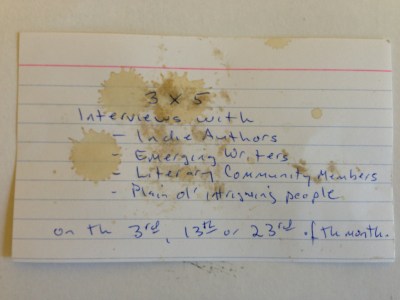
VAH: (Laugh) And there you have it – Linda Simone thanks for the visit with Three by Five. More Linda coming over this month, on days that have a three in them.
Linda Simone is a poet who also writes essay and is working on a novel in the Southern Gothic tradition. Her essays have appeared in Cezanne’s Carrot, Italian Americana, Journal of the Imagination in Language Learning, The Journal News, The New York Times, and on Purse Stories. Valparaiso Review published her review of poet Kevin Pilkington’s work. Find her poems in numerous journals including Assisi, Cyclamens and Swords. Her work is in a number of anthologies, including: the award-winning, Cradle Songs: An Anthology of Poems on Motherhood; Lavanderia; and Wait a Minute: I Have to Take Off My Bra. Her chapbook, Cow Tippers, won the Shadow Poetry Chapbook Competition. Linda’s 15-poem sequence, “The Stations of the Cross,” was nominated for a Pushcart Prize by Martin Willitts, Jr., editor of the 2007 anthology, Alternatives to Surrender. The anthology included works by 61 poets from around the globe, dealing with cancer, survival from cancer, death from cancer, and with loss and recovery. Linda and her husband live in New York City.
Linda on the web:
Twitter. Facebook. LinkedIn.
Linda reads her poem Grapefruit as part o fAlimentum’s Menupoems 2010:
Linda Simone on Three by Five in the month of September on the 3rd, 13th, 23rd and 30th.




 Vicki Hudson