Three by Five with a Glimpse into the Writing Life of Poet Mildred Achoch
Three by Five returns today with a late Part II and in penance for that, combined with Part III.
VAH: When did you begin to see yourself as a Writer? MA: When I wrote my first novel when I was sixteen. I began writing it during the school holidays then took it with me to (boarding) school and has my classmates read it as I completed writing it. It was their comments that helped me to see that I was good at writing. But more importantly, it was the fact that I immensely enjoyed reading my own writing!
VAH: What’s your best advice for emerging writers?
MA: Best advice for emerging writers? DON’T EMERGE! Just stay in your closet. In fact, give up writing! Don’t even think of making it your career! Get a nice, safe, 9 to 5 job! However, if all the above words went in one eye and came out your other eye, then congratulations! You are a writer. And nothing anyone tells you will make you quit!
VAH: “A nice, safe, 9 – 5 job!” That’s a great way to sum up what writing is not for so many of us. Now, the writing community – do you have a favorite writing conference or retreat? MA: I haven’t had a chance to attend any conferences or writing retreats/seminars but I have attended several workshops on screenwriting. I would love to attend a screenwriting conference or retreat.
VAH: Mildred, you’re a full time writer, if not writing, what would you be doing? MA: Yes, I am a full time writer, to the horror and great disappointment of those near and dear to me! If I wasn’t a writer, I would be the lead singer/songwriter of a rock ‘n’ roll band.
VAH: Certainly still an expression of your creativity. When reading for yourself, what type of books do you most enjoy reading? MA: I LOVE paranormal romances. I also enjoy science fiction.
VAH: Rock star or Author, who would play you in the Life and Times of Mildred Achoch?
MA: I don’t know who would play me but the theme song would be “Beautiful Day” by U2 because it’s such an uplifting song and I can’t get enough of it!
VAH: You suddenly gained a super power – what is yours? MA: Speed. So that I could write and type faster!
VAH: Writers read, what kind of reader are you? MA: I’m the kind of reader who can read three books at a go. One day, I may be in the mood for paranormal romance. So I wold begin to read that kind of book. Then the next day I could be in the mood for science fiction, so I would begin reading a science fiction book. The next day a biography. [Reading] just depends on my mood. And sometimes the location. I would carry the biography with me and read it “on the go” but the paranormal romance and science fiction novels I would prefer to read in the comfort of my home.
VAH: Writing every day as your paying job, what gets you over writer’s block? MA: The rent being due!
VAH: Accounts due certainly have a way to motivate. Thank you Mildred Achoch for the glimpse into your writing life. The final installment with Mildred will post on November 30th.
Mildred Achoch writes poems and screenplays and has two blogs – Kenya Rock Film Festival Journal and Lost in Cyberspace and Other Found Poems. In 2013, she was a participating poet with the Found Poetry Review’s Pulitzer Remix Project.
Thanks for joining us Mildred. We’ll be back later in the month with more from this young writer.
Three by Five welcomes Mildred Achoch, a Poet and Screenwriter in Kenya.
Mildred Achoch writes poems and screenplays and has two blogs – Kenya Rock Film Festival Journal and Lost in Cyberspace and Other Found Poems. In 2013, she was a participating poet with the Found Poetry Review’s Pulitzer Remix Project.
VAH: Welcome to Three by Five, Mildred! Why do you write?
MA: I write because I can. I found out early enough that I could skillfully combine words so as to communicate creatively. I also write because I cannot not write! They say it takes about 21 days to form a habit. Well, I have been writing for way more than 21 days! I’m hopelessly hooked!
VAH: Tell us about your first story?
MA: My first story was an interracial teen romance novel. I wrote it in longhand and I still largely write in longhand. I wrote this story when I was sixteen. I still remember the song that inspired it. “I love you always forever” by Donna Lewis, specifically the line that goes: “You’ve got the most unbelievable blue eyes I’ve ever seen.”
VAH: Do you have a favorite literary character?
MA: My favorite literary character is Bella Swan of the “Twilight” series. I think it’s because I can relate to her on so many levels. We are both introverts, love books so much that we’d rather go to a bookstore than shop for clothes and we both love vampires 🙂 Also, we come from broken homes.
VAH: A gift of books is how they provide both reflection and relief of our reality. If you were stuck on a deserted island, what books would you want with you?
MA: The Twilight books of course! Because I literally never get tired of reading them! They are so well written, the characters are well developed and the themes are very close to home: loneliness, sacrifice, love.
VAH: What has impacted you the most in your development as a writer?
MA: Working as a freelance writer on odesk.com, a portal for freelancers. Working with strict deadlines really helped me to improve my speed in writing and even in thinking. I discovered that, at least in my case, writer’s block is largely just an excuse for me not to write! I also have had the chance to work on diverse writing projects: novels, children’s stories, screenplays, world creation, articles, e-books short stories and so on.
Thanks for joining us Mildred. We’ll be back later in the month with more from this young writer.
Welcome back to Three by Five for the third and final installment of an interview with Jerad Alexander.
VAH: Jerad, when the blank page stares back at you, what gets you over writers block?
JWA: I rarely have a moment when I’m at a loss of words when writing. If I do get to that point, however, I’ll typically stop and go right to work on something else, and then take another look at what has jammed me up and see if I have unraveled any of it. Considering my need to be writing… if that piece doesn’t want to cooperate, then another piece will.
VAH: That’s a very effective redirection. Not giving in to the blank page but working on something else. How do you then track what you send out for consideration and keep up with the results of your submissions?
JWA: Along with sites that use Submittable, I track everything with Excel spreadsheets. It seems to work great!
VAH: Jerad, what little known fact about you will amaze and or amuse?
JWA: When Anthrax was delivered to the Capitol Hill mail facility and Longworth Hall just down from Congress, I was a sample gatherer and decontamination team member. While in Longworth Hall, which was a ghost town akin to The Andromeda Strain, a friend of mine smuggled out individually wrapped cigars from a senator aide’s office. We decontaminated them and my friends and I shared them in the shade of the capitol building.
JWE: Following a horrible fad at the time, I did the “Harlem Shake” with a full car of friends at a stoplight here in Atlanta at around 2:30 am. Drinks may or may not have been involved. The only regret I have is I did not have my horse mask at the time. Anything to expand on the already-stunned and horrified expressions on the older couple in the car next to us…
VAH: Jerad, thank you for your service and welcome home.
Do you have a favorite, inspiring quotation?
JWA: I’ll give you two that have struck me of late:
“As things stand now, I am going to be a writer. I’m not sure that I’m going to be a good one or even a self-supporting one, but until the dark thumb of fate presses me to the dust and says ‘you are nothing’, I will be a writer.” – Hunter Thompson
“All you have to do is write the one true sentence. Write the truest sentence you know.” – Ernest Hemingway
VAH: Both excellent touchstones for any writer. Now, drawing our conversation to a close, what are three random non-writing related facts about you?
JWE: I love German cars, specifically Audi and older-model BMW’s and Mercedes. I’d love to one day own a late 80’s 560SL.
While I like spring and summer, autumn is my favorite time of year. It feels like I come alive more in the fall than any time of the year.
I have a huge love and respect for the art and craft of standup comedy. It is a jealous craft, and if I could devote more time and energy to it, I’d love to give that a serious go. But… writing is jealous enough.
Jerad W. Alexander – thanks for the insights and words of encouragement and spending a little with with Three by Five.
Jerad W. Alexander is a writer and the associate editor of the upcoming literary journal The Blue Falcon Review, an annual collection of military fiction. His novella, The Life of Ling Ling, was a finalist in the 2012 Serena McDonald Kennedy Prize for Fiction. His essay “On Our Next Stop in Modern War” was a finalist is the Narrative Magazine Spring 2013 Contest. From 1998 to 2006 he served as a U.S. Marine infantryman and combat correspondent, deploying to the Mediterranean, the Horn of Africa, and Iraq. Since leaving the U.S. Marines he has earned a BA in English Literature from American Military University and is pursuing a Masters of Professional Studies in Strategic Public Relations at The George Washington University. He currently lives in Atlanta, Ga. His novella, The Life of Ling Ling, A Novella about Iraq, is available on Amazon.com. He can be found on Twitter and Facebook.
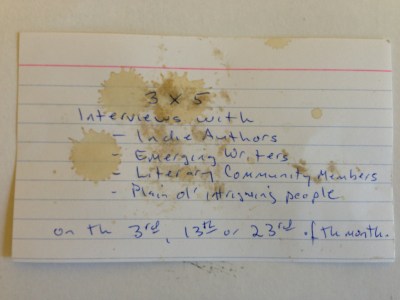
Three by Five – Five questions answered by authors, artists and interesting people published on days that end in three.
VAH: Jerad, What got you to the point where you knew you were a writer?
JWA: I’m not sure I ever had an “awaking” of sorts. I’ve always written in one capacity or another. Up until the past decade I’ve always treated it like an appendage.
VAH: Best advice for emerging writers?
JWA: Write. Every. Day.
Ready. Good. Works.
There is no other way.
VAH: What are your thoughts on the Master of Fine Arts in writing?
JWA: I do not have an MFA. While I can’t speak to the networking/work shopping side of an MFA program, and at the risk of criticizing something I don’t fully understand, I’m wondering if perhaps one could simply read and write on their own and get a good grip on the craft without laying out the cash for something that will more likely not guarantee a return, given the marketplace. That isn’t a slam on MFA programs specifically, but I suspect a lot of the work can be done off campus.
VAH: Jerad, I have a MFA and I’d agree with you. There’s something to be said about a couple dedicated years with a small cohort and I think you are right about doing some dedicated reading, writing and I’ll add, having a good writing group or community. Do you have a favorite conference or writing retreat or seminar.
JWA: Admittedly, I have not attended any writing conferences, retreats, or seminars. This is something I need to rectify.
VAH: Writers tend to also be readers – What books or authors keep you up at night because you don’t want to put them down?
JWA: Without a doubt, Cormac McCarthy.
VAH: That’s some good reading. Jerad, thanks for joining us here at Three by Five. The final installment of an interview with Jerad Alexander will publish here on the 30th.
Jerad W. Alexander is a writer and the associate editor of the upcoming literary journal The Blue Falcon Review, an annual collection of military fiction. His novella, The Life of Ling Ling, was a finalist in the 2012 Serena McDonald Kennedy Prize for Fiction. His essay “On Our Next Stop in Modern War” was a finalist is the Narrative Magazine Spring 2013 Contest. From 1998 to 2006 he served as a U.S. Marine infantryman and combat correspondent, deploying to the Mediterranean, the Horn of Africa, and Iraq. Since leaving the U.S. Marines he has earned a BA in English Literature from American Military University and is pursuing a Masters of Professional Studies in Strategic Public Relations at The George Washington University. He currently lives in Atlanta, Ga. His novella, The Life of Ling Ling, A Novella about Iraq, is available on Amazon.com. He can be found on Twitter and Facebook.
Three by Five – Five questions answered by authors, artists and interesting people published on days that end in three.
VAH: Jerad, welcome to Three by Five, where emerging writers, authors and other interesting people share a little about their writing, work and lives. First up, please tell us why you write?
JWA: I write because I have no choice. I don’t mean that in any forced-upon way, I just really feel like I must write. If I don’t, after a day or two I begin to feel unproductive and maybe even a little depressed or otherwise despondent. It’s almost weird… after a heavy writing jaunt I tend to feel a little tired, but really great, much like after a good workout. Aside from that, I write because I like a really good sentence and want to come up with the best I can. There is a positive challenge aspect to writing that gets overlooked a lot, I feel. It’s a personal challenge for me to come up with the best, most honest sentence possible. I think there is something about the creative written word that when done well can really put a hook in you and alter your worldview better than any television show or film or piece of artwork.
VAH: The power of the written word! Sounds like its intrinsic, a force within. What was that first expression of your drive to write? Your first story…?
JWA: My first story was about Joshua Lawrence Chamberlain that I wrote in high school for a history class. Chamberlain was a Maine rhetoric and world religions professor who went off to serve for the Union in the Civil War. All I basically did was write a fictionalized account of his actions at Gettysburg. I’d always play around with paragraphs or short stories that I never finished, but I managed to pull that off on somehow. Though I received an A for the work, I couldn’t tell you if it was good or not… likely not.
VAH: What about literary characters? Do you have a favorite?
JWE: Some of my favorite literary characters include Nick Adams from Hemingway, Raoul Duke (which is more alter-ego than fictional) from Hunter Thompson, Henry Chinaski from the Bukowski novels, Robert E. Lee Prewitt and Milton Warden from From Here To Eternity, Sam Spade from The Maltese Falcon. I’m sure I’m missing a couple hundred here…
VAH: Robert E. Lee Prewitt is a great example of a complex character. He’s one of my favorites and From Here to Eternity is one of my favorite novels (and movies). But if you were stranded on a deserted island, or snowed in at a deserted cabin with no power, what would you want to have with you?
JWE: Easy. I’d take the entire Twilight series and the entire Fifty Shades series. I figure there are at least three, if not four thousand pages of text between those two series. I can use a page or two a day as kindling to start a fire. Between the fire and the hot, nose-thumbing disregard and hatred I have for that brand of cheap, dubious literature I should be kept warm for days on end.
VAH: Well, there you go! A practical choice. Let’s be a little serious now, what was would you say has had the biggest influence on your development as a writer?
JWE: There are a couple of authors who’ve made an impact on my work. James Jones, Norman Mailer, and of course Hemingway are all big players, but I like 60’s and 70’s-era New Journalists as well. Journalists and memoirists like Hunter S. Thompson, Tom Wolfe, Gay Talese, Joan Didion and others really put their hook in me when I was younger. I’m also a big fan of James Ellroy.
VAH: Thanks Jerad! Our readers are invited to return on the 23rd for more and a bonus day post on the 30th.
Jerad W. Alexander is a writer and the associate editor of the upcoming literary journal The Blue Falcon Review, an annual collection of military fiction. His novella, The Life of Ling Ling, was a finalist in the 2012 Serena McDonald Kennedy Prize for Fiction. His essay “On Our Next Stop in Modern War” was a finalist is the Narrative Magazine Spring 2013 Contest. From 1998 to 2006 he served as a U.S. Marine infantryman and combat correspondent, deploying to the Mediterranean, the Horn of Africa, and Iraq. Since leaving the U.S. Marines he has earned a BA in English Literature from American Military University and is pursuing a Masters of Professional Studies in Strategic Public Relations at The George Washington University. He currently lives in Atlanta, Ga. His novella, The Life of Ling Ling, A Novella about Iraq, is available on Amazon.com. He can be found on Twitter and Facebook.
Three by Five – Five questions answered by authors, artists and interesting people published on days that end in three.
This month Three by Five hosted Poet Linda Simone. Linda lives in New York City with her husband. She predominantly writes poetry, but has also published essays. She is working on a novel in the Southern Gothic tradition. Her essays have appeared in Cezanne’s Carrot, Italian Americana, Journal of the Imagination in Language Learning, The Journal News, The New York Times, and on pursestories.com. Valparaiso Review published her review of poet Kevin Pilkington’s work. Her poems appear in numerous journals including Assisi, Cyclamens and Swords, and have been nominated for a Pushcart Prize. She has been published in a number of anthologies, including: the award-winning, Cradle Songs: An Anthology of Poems on Motherhood; Lavanderia; and Wait a Minute: I Have to Take Off My Bra. Her chapbook, Cow Tippers, won the Shadow Poetry Chapbook Competition.
Two bonus questions with Linda VAH: Three random non-writing related facts about you? LS: I’m an amateur watercolor painter…still trying to find my visual voice.
I had a childhood imaginary friend—Anne of Green Gables.
I love bluegrass and rock-a-billy music. VAH: If about to have your last meal, what would that be and why? LS: Last meal: Cavatelli with Broccoli, a bottle of red, followed by Red Velvet Cake, vanilla ice cream, and a cup of Earl Grey tea with milk—and it better be Twinnings!
Why? Because in my next life, I may come back as a dog, hopefully a well-loved one, so I’ll probably be eating Kibble and Bits.
VAH: Linda, there are two kinds of readers – The finish-the-book-once-you’ve-started kind and the leave-it and move on-if-don’t-like-the-book sort – which kind are you?
LS: My Catholic school background (and Ms. Nora Claire Sharkey) taught me to give the author the courtesy of reading the whole book. However, I’ve rebelled over the past few years. If the book doesn’t grab me in 50 pages, you lose me…so many books, and so little time.
VAH: Every writer faces this at some time or another – the blank page stares back at you, what gets you over writers block?
LS: Reading to those who don’t usually get the chance to connect to poetry – their reactions are fresh, honest, and often inspiring. Also, writing in a journal – I used to do it almost every day…I’m afraid it is now only sporadic. I always seem to unearth things that sound like they could blossom into an idea for a poem or essay. Another source for inspiration: reading titles of articles in women’s magazines –they form rich prompts. And finally, viewing a painting or other piece of art and choosing a point of view from inside the tableau.
VAH: An example prompted by an article in a magazine?
LS: I wrote a poem called “Simple Storage Solutions” that was instigated from an article in Family Circle).
VAH: Brass tacks of the writing life – what do you do in order to keep up with what you send out and results of your submissions?
LS: This is hard. I used to keep paper copies in a manila folder. Then I created a spreadsheet. But really, I wish someone would do it for me. Every year on the 31st of December, I spend time sending out work so that there is always hope and possibility for the New Year.
VAH: Totally get that! Sometimes December is my most productive month of the whole year! What is an interesting little known fact about you?
LS: My middle name is Ann Ann. No, that’s not a typo. The reason is that Linda is not a saint’s name, so my parents had to select a middle name that was. I was Christened Linda Ann. Being the feisty, stubborn 4th grader that I was, when it came time to choose a Confirmation name, I decided that I didn’t want 4 names – I wanted to stick with a trinity of names. So I picked Ann again. Linda Ann squared.
VAH: What is your favorite, inspiring quote?
LS: I like this by Leonard Cohen, because it says it’s okay to make mistakes, in fact, maybe it’s preferable:
Ring the bells that still can ring
Forget your perfect offering
There is a crack in everything–
That’s how the light gets in.
VAH: Thanks Linda! That’s a good concept to end upon – that it’s okay to make mistakes.
The second installment of this month’s Three by Five interview with Linda Simone
VAH: Linda, what’s your best advice for emerging writers?
LS: I was lucky to be nurtured along the way, so nurturing writers and passing it forward is one of my favorite things. This is want I did for over four years, as Assistant Director of the Masters of Arts in Writing program at Manhattanville College. Students were always tenuous in their confidence as writers. Whenever I advised or taught students, I’d ask them to trust me and to trust themselves because their writing was always better than they thought. So to emerging writers I say: self-doubt is your own worst enemy. You need to go with your gut and trust your ear. Be honest. Be brave. Read it out loud. You’ll know when a line or a paragraph rings true and the real you shines through. That’s your tuning fork.
VAH: That is a terrific validation – “You’ll know when a line or a paragraph rings true…” When did you know you were a writer and how did that manifest for you?
LS: I realized that I wasn’t a Major Medical contract writer (actually I was but was dying a small slow death from lack of a creative outlet). When the job was downsized and I got a generous bonus and severance, it was a blessing in disguise. I used that money to start my own freelance editorial business to earn a living, and then joined the National Writers Union to nourish my more creative, personal writing. In the mid-1980s, the Writers Union gave me the community of writers I needed.
I came to the Writers Union member via my first Writers’ Conference sponsored by the Union’s Westchester Chapter. I was so pumped by what I learned from the teaching writers, and so enthused by the collegiality I felt from fellow attendees, that I felt like Columbus discovering America. I had no idea what was out there—a sea of writers struggling with the same things I was struggling with. It was the beginning of learning the “how tos” of improving my writing, and marketing it.
I eventually joined the Chapter and formed friendships that I cherish to this day. It’s where I met my Sapphires. From Sarah, the Chapter’s charismatic President, I learned more about real leadership than from any corporate job I’ve ever held. For the past dozen or so years, we venture to Ann’s Vermont home for an annual “writing and acting silly” retreat. Before we leave, we discuss each other’s writing and what our plans and dreams are for the coming months.
VAH: And formal writing education, such as the MFA? Is it worthwhile?
LS: I have a Masters of Arts in Creative Writing from Manhattanville College. The school has since gone to an MFA, but my work schedule and a move to Manhattan made it impossible to take advantage of upgrading my degree. Has it helped my career or development? I’d have to say it has in these ways: it connects you with teachers of writing, some better than others, but you learn from both. It provides a community of writers—who see your work develop and whose work you see develop. Perhaps its biggest value to me is validation– it validated me in my own mind as a writer. This, of course, is not necessary, but a lot of people, like me, need the diploma to feel “legitimate.” Do I think the degree is necessary? Absolutely, if you want to teach. Relatively, if you think it is. But really, to be a writer doesn’t require a degree. It requires writing, reading, rewriting, and interacting with your own community of writers—even if that is just one other person you trust who also writes and with whom you can share your work and give and get constructive critique.
For me, it’s been a worthwhile experience. I’m glad I did it. It energized my work and exposed me to writers and poets I probably never would have read. It helped in recognizing my voice. And let’s not forget the benefit of a deadline – when you have an assignment due, you sit your butt down and write. No procrastination allowed.
VAH: That structure of the formal academic setting and demand of weekly workshop certainly teaches skills for keeping procrastination at bay. Your statement though that “to be a writer doesn’t require a degree” I think is vitally important. The community of writers is there be that in formal study or not. With community of writers in mind, do you have a favorite conference or writing retreat or seminar?
LS: I do love Manhattanville College’s Summer Writer’s Week. I’ve always found it to be a wonderfully energizing, soul-feeding and exhausting 4-1/2-day immersion into writing. I went as a writer and I also ran it for four years as an administrator and loved it from both perspectives.
VAH: Writing as occupation – how is that for you? And if you weren’t writing, what would your work be instead?
LS: I am a full-time writer of corporate communications. It’s hectic, but I love it because it allows me to make sure that our 2500+ employees at all levels within our organization–as well as external stakeholders–get the messages and news they need. I take this job very seriously. When the message is clear and engaging, there’s more action, less dissatisfaction, and less time wasted. That said, if I had to choose any occupation other than a writer, I’d want to be a visual artist. I guess I’m just destined to a life of rejection and starvation.
VAH: Linda welcome to Three by Five. Let’s start with what was your first story?
LS: I wrote a science fiction story as a kid, and all I can remember is that the main character was named Jason Ramses and my English teacher said it was very good. Later, in my twenties, I worked on an autobiographical (of course) non-fiction manuscript about my love/hate relationship with nuns. Immersed in Catholic Schools throughout the 50s and 60s, I experienced all those crazy things you may have read about, but can’t imagine to be true. I assure you, being told not to wear patent leather shoes because they can reflect your underwear happened to me – and it wasn’t the worst of it. The manuscript, which patiently awaits my return from its hallowed spot in my file cabinet, was titled Class Trips.
The branch of Catholicism I subscribe to is “lapsed.” But my Catholic school experiences remain to this day a recurring theme in both my prose and poetry.
VAH: Let’s expand on that a bit with the question why do you write?
LS: Ah, that’s the question I’ve been trying to figure out longer than I want to admit. To simply say, because I have to, while it’s true, seems trite and clichéd. I’ve spent scores of years trying to sort out who I am and writing, particularly poetry, figures in that quest in a big way.
As a 9-year-old, I discovered that poetry, to paraphrase Emily Dickinson, blew off the top of my head. I remember the experience well–The First Snowfall by James Russell Lowell. It captured my attention like nothing had ever done before. From the first stanza–The snow had begun in the gloaming / and busily through the night / had been heaping field and highway / with a silence deep and white – to the last line, I was hooked. The rhythm, rhyme, and diction blew me away. And ever since, whenever anyone asked me what I wanted to be when I grew up, I answered: a writer. But, it’s been a circuitous road
Writing in general, and poetry in particular, was my golden fleece throughout grammar school (poems by Frost, Dickinson, Lear, Yeats; also the usual Nancy Drew & Bobsey Twins fare). I loved having a summer reading list for school.
In high school, I learned by reading Ferlinghetti, Ginsburg, Kunitz, and others. Enter Shakespeare and the discovery that one could use poetry to tell a long, complex story within a play.
Through those years I wrote (pretty bad) poetry and (mediocre) stories that I would not share with anyone, because to me, writing was personal, like a diary.
So why do I write? Because I love words. Because writing is the way I think and work out problems. Because writing is the way I get in touch with feelings, and it’s how I explore possibilities that I might never actualize. I write because writing is in my DNA. It’s what I do best.
VAH: Do you have a favorite literary character?
LS: As an adult, I’ve utterly fallen in love with the unlikely anti-hero, Ignatius J. Riley, from John Kennedy Toole’s Confederacy of Dunces. Which brings up the other recurring theme in my prose and poetry—misfits, particularly those portrayed in the Southern Gothic tradition. I’m obsessed with them, perhaps because like me, “everyman” is in them. It’s impossible not to rattle off a long list, but some of my favorites include: any character from Carson McCullers’ body of work including Ms. Amelia Evans and Cousin Lymon in The Ballad of the Sad Café; Flannery O’Connor’s Enoch Emery in Wise Blood; and Nathaniel West’s Lemuel Pitkin in A Cool Million as well as the title character in Miss Lonelyhearts. I can read these books tirelessly because of the rich character-driven stories, eccentricities, and incredibly poetic language.
Melba McIntyre, the main character in my novel-in-progress (tentatively titled Preacher Girl), is a humble attempt at characterization in that tradition.
VAH: Linda, what would you say has been the biggest influence on your development as a writer?
LS: I’ve learned different things from a wide range of people, so it’s impossible to name one person. If you really pushed, I’d have to say Thomas Lux, who made me understand that a good poem has to morph through 25 drafts. A summer session I took with him was writing-life-changing. Others who influenced me: Eamon Grennan, who taught me a poem’s opening is often just scaffolding and needs to be knocked down; Kevin Pilkington, who showed me that beauty worthy of a poem can come not only from the bucolic countryside, but also from gritty, cityscapes and experiences. Emily Dickinson’s poetry is a master class in rhythm, music, and brevity. And from Robert Frost, I learned that nature is like a bible from which the poet can cite chapter and verse.
I also learned from three friends. Together call ourselves The Sapphires. Ann Cefola, Terry Dugan, and Sarah Bracey White generously offer laser critique, and demonstrate bravery and fearlessness in their writing – and infinite patience. (Sarah’s memoir, Primary Lessons, is coming out in September 2013 from CavanKerry Press—let’s just say she’s paid her dues).
And having a supportive family is really a blessing. My son, Justin, has a poet’s sensibilities and always helps me make my poems better. My daughter-in-law, Nicole, who’s an avid reader and an artist, has included my writing in her paintings. And my toughest, most honest critic is my husband, Joe. Like El Exigente, when Joe says a poem is good, I do a happy dance because his opinion holds weight.
VAH: You spread the credit around. I enjoy this question as it almost always generates authors to investigate that I’m not familiar with and have influenced the writers interviewed here at Three by Five. Sarah Bracey White was here July and is a terrific storyteller.
Now let’s take you away and strand you on a deserted island. What would you be reading that you just happened to be able to take with you?
LS: Since I live in a tight NYC apartment, my bookshelf is already “bare essentials” and holds: poetry collections by Thomas Lux, Kevin Pilkington, Mary Oliver, Eamon Grennan, Robert Frost, and Emily Dickinson; Pablo Neruda’s Odes to Common Things; The Curious Incident of the Dog in the Night-time by Mark Haddon; a 50-page gem about translation called 19 Ways of Looking at Wang Wei by Eliot Weinberger and Octavio Paz; and my friend, Ann Cefola’s chapbook, Sugaring. Would this deserted island have WiFi by any chance? Then I’d have a ton of ebooks.
VAH: (Laugh) And there you have it – Linda Simone thanks for the visit with Three by Five. More Linda coming over this month, on days that have a three in them.
Linda Simone is a poet who also writes essay and is working on a novel in the Southern Gothic tradition. Her essays have appeared in Cezanne’s Carrot, Italian Americana, Journal of the Imagination in Language Learning, The Journal News, The New York Times, and on Purse Stories. Valparaiso Review published her review of poet Kevin Pilkington’s work. Find her poems in numerous journals including Assisi, Cyclamens and Swords. Her work is in a number of anthologies, including: the award-winning, Cradle Songs: An Anthology of Poems on Motherhood; Lavanderia; and Wait a Minute: I Have to Take Off My Bra. Her chapbook, Cow Tippers, won the Shadow Poetry Chapbook Competition. Linda’s 15-poem sequence, “The Stations of the Cross,” was nominated for a Pushcart Prize by Martin Willitts, Jr., editor of the 2007 anthology, Alternatives to Surrender. The anthology included works by 61 poets from around the globe, dealing with cancer, survival from cancer, death from cancer, and with loss and recovery. Linda and her husband live in New York City.
Linda Simone is a poet who also writes essay and is working on a novel in the Southern Gothic tradition. Her essays have appeared in Cezanne’s Carrot, Italian Americana, Journal of the Imagination in Language Learning, The Journal News, The New York Times, and on Purse Stories. Valparaiso Review published her review of poet Kevin Pilkington’s work. Find her poems in numerous journals including Assisi, Cyclamens and Swords. Her work is in a number of anthologies, including: the award-winning, Cradle Songs: An Anthology of Poems on Motherhood; Lavanderia; and Wait a Minute: I Have to Take Off My Bra. Her chapbook, Cow Tippers, won the Shadow Poetry Chapbook Competition. Linda’s 15-poem sequence, “The Stations of the Cross,” was nominated for a Pushcart Prize by Martin Willitts, Jr., editor of the 2007 anthology, Alternatives to Surrender. The anthology included works by 61 poets from around the globe, dealing with cancer, survival from cancer, death from cancer, and with loss and recovery. Linda and her husband live in New York City.
Newsletter Signup. Let's trade!
Signup for news, info, and updates. In return, I’ll give you the secret link to Tips from No Red Pen: Writers, Writing Groups & Critique.
Download No Red Pen: Writers, Writing Groups & Critique or the short Ebook Chow (now .99 cents) in the iBookstore, Barns & Noble, Kobo, Diesel, Smashwords and many other Ebook venues. Portions of Chow’s price goes towards development of a Veteran’s MFA Writing Scholarship. Both listed under author name Victoria A Hudson.
Author First Look
First look provides a read of an emerging writer or indie author’s work in progress via a link to their posted first chapter. These are works in progress – so don’t expect perfection. Check the Author’s Bio for how to connect with the writer and if the writer wants feedback or comment. Enjoy the story, essay or poem. Perhaps it will whet your desire for a future book purchase so you can find out what happens next!
Do please comment here on this site, on my facebook page or on Twitter, especially if you enjoy this series once it gets going. Please use hashtag #AuthorFirstLook. Thanks for reading.
Authors retain all rights.
How to get your own first chapter posted:
Your chapter or series of 3-5 poems should be posted on your website. Send an email with the permalink and I will link back to your site. Include your short Bio (no more than about 100 words) and any comment about the work or a series synopsis for posting on First Look Pages. If the book is part of a series, give a spoiler warning if warranted.The link to your site will be embedded in your Bio. If you want reader input, be sure to write that in your comments. Once your book is published, make sure to send me the news and I’ll update your Bio.
Located via the link in the menu at the top of the page. Enjoy your First Look.
Three by Five
Free Literary Magazines aka Recycle Reading
I read a ton of literary magazines. Tossing them in the recycle bin seems so….wrong. Would you like one? Just send me a message on twitter @Vickigeist with snail mail information and I’ll send you one. If so inclined, you can snail a buck or two for the postage. P.O. Box 387, Hayward, CA 94543. You can also just snail a request in if you’d rather with or without that buck or two.

 MA: When I wrote my first novel when I was sixteen. I began writing it during the school holidays then took it with me to (boarding) school and has my classmates read it as I completed writing it. It was their comments that helped me to see that I was good at writing. But more importantly, it was the fact that I immensely enjoyed reading my own writing!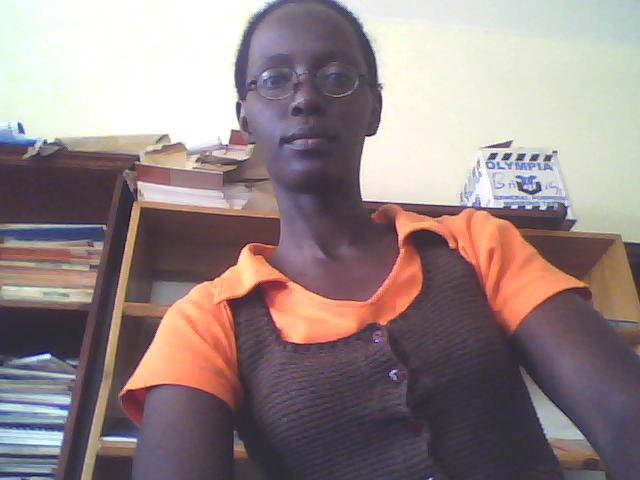








 Vicki Hudson