VAH: Linda, there are two kinds of readers – The finish-the-book-once-you’ve-started kind and the leave-it and move on-if-don’t-like-the-book sort – which kind are you?
LS: My Catholic school background (and Ms. Nora Claire Sharkey) taught me to give the author the courtesy of reading the whole book. However, I’ve rebelled over the past few years. If the book doesn’t grab me in 50 pages, you lose me…so many books, and so little time.
VAH: Every writer faces this at some time or another – the blank page stares back at you, what gets you over writers block?
LS: Reading to those who don’t usually get the chance to connect to poetry – their reactions are fresh, honest, and often inspiring. Also, writing in a journal – I used to do it almost every day…I’m afraid it is now only sporadic. I always seem to unearth things that sound like they could blossom into an idea for a poem or essay. Another source for inspiration: reading titles of articles in women’s magazines –they form rich prompts. And finally, viewing a painting or other piece of art and choosing a point of view from inside the tableau.
VAH: An example prompted by an article in a magazine?
LS: I wrote a poem called “Simple Storage Solutions” that was instigated from an article in Family Circle).
VAH: Brass tacks of the writing life – what do you do in order to keep up with what you send out and results of your submissions?
LS: This is hard. I used to keep paper copies in a manila folder. Then I created a spreadsheet. But really, I wish someone would do it for me. Every year on the 31st of December, I spend time sending out work so that there is always hope and possibility for the New Year.
VAH: Totally get that! Sometimes December is my most productive month of the whole year! What is an interesting little known fact about you?
LS: My middle name is Ann Ann. No, that’s not a typo. The reason is that Linda is not a saint’s name, so my parents had to select a middle name that was. I was Christened Linda Ann. Being the feisty, stubborn 4th grader that I was, when it came time to choose a Confirmation name, I decided that I didn’t want 4 names – I wanted to stick with a trinity of names. So I picked Ann again. Linda Ann squared.
VAH: What is your favorite, inspiring quote?
LS: I like this by Leonard Cohen, because it says it’s okay to make mistakes, in fact, maybe it’s preferable:
Ring the bells that still can ring
Forget your perfect offering
There is a crack in everything–
That’s how the light gets in.
VAH: Thanks Linda! That’s a good concept to end upon – that it’s okay to make mistakes.
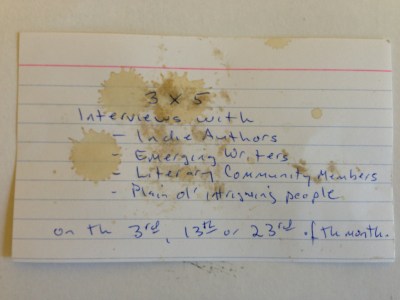
The second installment of this month’s Three by Five interview with Linda Simone
VAH: Linda, what’s your best advice for emerging writers?
LS: I was lucky to be nurtured along the way, so nurturing writers and passing it forward is one of my favorite things. This is want I did for over four years, as Assistant Director of the Masters of Arts in Writing program at Manhattanville College. Students were always tenuous in their confidence as writers. Whenever I advised or taught students, I’d ask them to trust me and to trust themselves because their writing was always better than they thought. So to emerging writers I say: self-doubt is your own worst enemy. You need to go with your gut and trust your ear. Be honest. Be brave. Read it out loud. You’ll know when a line or a paragraph rings true and the real you shines through. That’s your tuning fork.
VAH: That is a terrific validation – “You’ll know when a line or a paragraph rings true…” When did you know you were a writer and how did that manifest for you?
LS: I realized that I wasn’t a Major Medical contract writer (actually I was but was dying a small slow death from lack of a creative outlet). When the job was downsized and I got a generous bonus and severance, it was a blessing in disguise. I used that money to start my own freelance editorial business to earn a living, and then joined the National Writers Union to nourish my more creative, personal writing. In the mid-1980s, the Writers Union gave me the community of writers I needed.
I came to the Writers Union member via my first Writers’ Conference sponsored by the Union’s Westchester Chapter. I was so pumped by what I learned from the teaching writers, and so enthused by the collegiality I felt from fellow attendees, that I felt like Columbus discovering America. I had no idea what was out there—a sea of writers struggling with the same things I was struggling with. It was the beginning of learning the “how tos” of improving my writing, and marketing it.
I eventually joined the Chapter and formed friendships that I cherish to this day. It’s where I met my Sapphires. From Sarah, the Chapter’s charismatic President, I learned more about real leadership than from any corporate job I’ve ever held. For the past dozen or so years, we venture to Ann’s Vermont home for an annual “writing and acting silly” retreat. Before we leave, we discuss each other’s writing and what our plans and dreams are for the coming months.
VAH: And formal writing education, such as the MFA? Is it worthwhile?
LS: I have a Masters of Arts in Creative Writing from Manhattanville College. The school has since gone to an MFA, but my work schedule and a move to Manhattan made it impossible to take advantage of upgrading my degree. Has it helped my career or development? I’d have to say it has in these ways: it connects you with teachers of writing, some better than others, but you learn from both. It provides a community of writers—who see your work develop and whose work you see develop. Perhaps its biggest value to me is validation– it validated me in my own mind as a writer. This, of course, is not necessary, but a lot of people, like me, need the diploma to feel “legitimate.” Do I think the degree is necessary? Absolutely, if you want to teach. Relatively, if you think it is. But really, to be a writer doesn’t require a degree. It requires writing, reading, rewriting, and interacting with your own community of writers—even if that is just one other person you trust who also writes and with whom you can share your work and give and get constructive critique.
For me, it’s been a worthwhile experience. I’m glad I did it. It energized my work and exposed me to writers and poets I probably never would have read. It helped in recognizing my voice. And let’s not forget the benefit of a deadline – when you have an assignment due, you sit your butt down and write. No procrastination allowed.
VAH: That structure of the formal academic setting and demand of weekly workshop certainly teaches skills for keeping procrastination at bay. Your statement though that “to be a writer doesn’t require a degree” I think is vitally important. The community of writers is there be that in formal study or not. With community of writers in mind, do you have a favorite conference or writing retreat or seminar?
LS: I do love Manhattanville College’s Summer Writer’s Week. I’ve always found it to be a wonderfully energizing, soul-feeding and exhausting 4-1/2-day immersion into writing. I went as a writer and I also ran it for four years as an administrator and loved it from both perspectives.
VAH: Writing as occupation – how is that for you? And if you weren’t writing, what would your work be instead?
LS: I am a full-time writer of corporate communications. It’s hectic, but I love it because it allows me to make sure that our 2500+ employees at all levels within our organization–as well as external stakeholders–get the messages and news they need. I take this job very seriously. When the message is clear and engaging, there’s more action, less dissatisfaction, and less time wasted. That said, if I had to choose any occupation other than a writer, I’d want to be a visual artist. I guess I’m just destined to a life of rejection and starvation.
VAH: Linda welcome to Three by Five. Let’s start with what was your first story?
LS: I wrote a science fiction story as a kid, and all I can remember is that the main character was named Jason Ramses and my English teacher said it was very good. Later, in my twenties, I worked on an autobiographical (of course) non-fiction manuscript about my love/hate relationship with nuns. Immersed in Catholic Schools throughout the 50s and 60s, I experienced all those crazy things you may have read about, but can’t imagine to be true. I assure you, being told not to wear patent leather shoes because they can reflect your underwear happened to me – and it wasn’t the worst of it. The manuscript, which patiently awaits my return from its hallowed spot in my file cabinet, was titled Class Trips.
The branch of Catholicism I subscribe to is “lapsed.” But my Catholic school experiences remain to this day a recurring theme in both my prose and poetry.
VAH: Let’s expand on that a bit with the question why do you write?
LS: Ah, that’s the question I’ve been trying to figure out longer than I want to admit. To simply say, because I have to, while it’s true, seems trite and clichéd. I’ve spent scores of years trying to sort out who I am and writing, particularly poetry, figures in that quest in a big way.
As a 9-year-old, I discovered that poetry, to paraphrase Emily Dickinson, blew off the top of my head. I remember the experience well–The First Snowfall by James Russell Lowell. It captured my attention like nothing had ever done before. From the first stanza–The snow had begun in the gloaming / and busily through the night / had been heaping field and highway / with a silence deep and white – to the last line, I was hooked. The rhythm, rhyme, and diction blew me away. And ever since, whenever anyone asked me what I wanted to be when I grew up, I answered: a writer. But, it’s been a circuitous road
Writing in general, and poetry in particular, was my golden fleece throughout grammar school (poems by Frost, Dickinson, Lear, Yeats; also the usual Nancy Drew & Bobsey Twins fare). I loved having a summer reading list for school.
In high school, I learned by reading Ferlinghetti, Ginsburg, Kunitz, and others. Enter Shakespeare and the discovery that one could use poetry to tell a long, complex story within a play.
Through those years I wrote (pretty bad) poetry and (mediocre) stories that I would not share with anyone, because to me, writing was personal, like a diary.
So why do I write? Because I love words. Because writing is the way I think and work out problems. Because writing is the way I get in touch with feelings, and it’s how I explore possibilities that I might never actualize. I write because writing is in my DNA. It’s what I do best.
VAH: Do you have a favorite literary character?
LS: As an adult, I’ve utterly fallen in love with the unlikely anti-hero, Ignatius J. Riley, from John Kennedy Toole’s Confederacy of Dunces. Which brings up the other recurring theme in my prose and poetry—misfits, particularly those portrayed in the Southern Gothic tradition. I’m obsessed with them, perhaps because like me, “everyman” is in them. It’s impossible not to rattle off a long list, but some of my favorites include: any character from Carson McCullers’ body of work including Ms. Amelia Evans and Cousin Lymon in The Ballad of the Sad Café; Flannery O’Connor’s Enoch Emery in Wise Blood; and Nathaniel West’s Lemuel Pitkin in A Cool Million as well as the title character in Miss Lonelyhearts. I can read these books tirelessly because of the rich character-driven stories, eccentricities, and incredibly poetic language.
Melba McIntyre, the main character in my novel-in-progress (tentatively titled Preacher Girl), is a humble attempt at characterization in that tradition.
VAH: Linda, what would you say has been the biggest influence on your development as a writer?
LS: I’ve learned different things from a wide range of people, so it’s impossible to name one person. If you really pushed, I’d have to say Thomas Lux, who made me understand that a good poem has to morph through 25 drafts. A summer session I took with him was writing-life-changing. Others who influenced me: Eamon Grennan, who taught me a poem’s opening is often just scaffolding and needs to be knocked down; Kevin Pilkington, who showed me that beauty worthy of a poem can come not only from the bucolic countryside, but also from gritty, cityscapes and experiences. Emily Dickinson’s poetry is a master class in rhythm, music, and brevity. And from Robert Frost, I learned that nature is like a bible from which the poet can cite chapter and verse.
I also learned from three friends. Together call ourselves The Sapphires. Ann Cefola, Terry Dugan, and Sarah Bracey White generously offer laser critique, and demonstrate bravery and fearlessness in their writing – and infinite patience. (Sarah’s memoir, Primary Lessons, is coming out in September 2013 from CavanKerry Press—let’s just say she’s paid her dues).
And having a supportive family is really a blessing. My son, Justin, has a poet’s sensibilities and always helps me make my poems better. My daughter-in-law, Nicole, who’s an avid reader and an artist, has included my writing in her paintings. And my toughest, most honest critic is my husband, Joe. Like El Exigente, when Joe says a poem is good, I do a happy dance because his opinion holds weight.
VAH: You spread the credit around. I enjoy this question as it almost always generates authors to investigate that I’m not familiar with and have influenced the writers interviewed here at Three by Five. Sarah Bracey White was here July and is a terrific storyteller.
Now let’s take you away and strand you on a deserted island. What would you be reading that you just happened to be able to take with you?
LS: Since I live in a tight NYC apartment, my bookshelf is already “bare essentials” and holds: poetry collections by Thomas Lux, Kevin Pilkington, Mary Oliver, Eamon Grennan, Robert Frost, and Emily Dickinson; Pablo Neruda’s Odes to Common Things; The Curious Incident of the Dog in the Night-time by Mark Haddon; a 50-page gem about translation called 19 Ways of Looking at Wang Wei by Eliot Weinberger and Octavio Paz; and my friend, Ann Cefola’s chapbook, Sugaring. Would this deserted island have WiFi by any chance? Then I’d have a ton of ebooks.
VAH: (Laugh) And there you have it – Linda Simone thanks for the visit with Three by Five. More Linda coming over this month, on days that have a three in them.
Linda Simone is a poet who also writes essay and is working on a novel in the Southern Gothic tradition. Her essays have appeared in Cezanne’s Carrot, Italian Americana, Journal of the Imagination in Language Learning, The Journal News, The New York Times, and on Purse Stories. Valparaiso Review published her review of poet Kevin Pilkington’s work. Find her poems in numerous journals including Assisi, Cyclamens and Swords. Her work is in a number of anthologies, including: the award-winning, Cradle Songs: An Anthology of Poems on Motherhood; Lavanderia; and Wait a Minute: I Have to Take Off My Bra. Her chapbook, Cow Tippers, won the Shadow Poetry Chapbook Competition. Linda’s 15-poem sequence, “The Stations of the Cross,” was nominated for a Pushcart Prize by Martin Willitts, Jr., editor of the 2007 anthology, Alternatives to Surrender. The anthology included works by 61 poets from around the globe, dealing with cancer, survival from cancer, death from cancer, and with loss and recovery. Linda and her husband live in New York City.
Welcome back for the final installment of this month’s Three by Five. Earlier, the discussion has been focused on writing, let’s explore beyond the writer a bit.
VAH: Jerome, if you had a super power, what and why that one?
JJG: Flight, no question, because the view’s spectacular from here. Sorry, I meant, from there.
What about this, what is your favorite, inspiring quote and why it works for you?
JJG: “The fact remains that getting people right is not what living is all about anyway. It’s getting them wrong that is living, getting them wrong and wrong and wrong and then, on careful reconsideration, getting them wrong again. That’s how we know we’re alive: we’re wrong.” Philip Roth, American Pastoral
When I found this quote in context, it meant a lot to me, as I’d been trying to get some people I knew “right” for a piece of writing I was working on, and was failing. And I was failing to understand why I was failing. Reading these lines from Roth, and reading them in context, freed me to get them “wrong” and ultimately discard the entire project, one of most liberating actions I’ve ever taken as a writer.
I’d add this: my life in North Berkeley gives me many views of the body of water historically known as San Francisco Bay. For most of its long, geological existence, that body of water was not known by that particular name. In fact, the contours we now “know” so well, thanks to Google Maps and so forth, were not known by anyone, not even by the original inhabitants of the area. They hadn’t been explored. No one had gone out to see them, to look at them, to ponder them. But those contours existed, because that body of water exists and has existed a long time. It is already more enduring than anything we humans will ever make, any bridge, any boat, any software program. Getting that body of water “right,” therefore, is not the point, because we need darkness and fog and obscurity and the unknown to cross through or to wait out, however patiently or impatiently. In order to arrive, or fail to arrive. The body of water is utterly indifferent to all our efforts on its or our own behalf.
VAH: Tell me, what little known fact about you will amaze and or amuse Three by Five readers?
JJG: I’ve met and spoken with both Gwyneth Paltrow and Jennifer Aniston, the former at some length, and someone I once dated has worked professionally with both Justin Theroux and Angelina Jolie, so it’s just a matter of time before Brad Pitt, Chris Martin and I are best buds.
VAH: Ahh, fact with future aspiration.
Okay, how about three random non-writing related facts about you?
JJG: I am a great cook. I have a killer backhand. I live very, very modestly.
VAH: A great cook? Maybe I should fact check that. . What would your last meal be?
JJG: Kumamoto oysters on the half shell with mignonette sauce. The chilled golden tomato soup I once had at Zuni Café in San Francisco. A perfectly-done ribeye steak with top-quality French fries and truffle butter. An iceberg wedge with some ripe heirloom tomatoes and blue cheese dressing. And fresh pineapple sorbet. And I would prep and cook all of these things myself as part of their lastness.
These particular foods [for] my last meal, because these are the simple but delicious flavors, foods and textures that I loved in late adolescence and early adulthood. The circumstances that would make this my last meal? Because I have lived a life rich in love, laughter, learning, and joy and in experiences that generate those, a life that has been perfectly seasoned with other emotions and the experiences that generate them, like regret, grief, unfulfilled desire, and so forth. I would be eating that meal because I had accepted the fact that I was expected somewhere soon, somewhere unknown, and didn’t want to be late or hungry when I got there.
VAH: “I was expected somewhere soon, somewhere unknown, and didn’t want to be late or hungry when I got there.”
Welcome back to the August installment of Three by Five. This month, poet and playwright Jerome Joseph Gentes is the subject.
VAH: Jerome, what’s a page turner for you that keeps you up at night because you just can’t put it away?
JJG: This is going to sound pretentious, but Robert Fagles version of The Odyssey was the most recent page turner for me. Of course, it’s all about the desire to move and obstacles to movement. I’m trying to find out if his Iliad has the same or its own corollary qualities. I couldn’t read Philip Pullman’s His Dark Materials fast enough, and feel the same way about George R. R. Martin’s A Song of Ice and Fire. There are also many books I like to re-read again and again, like Pride and Prejudice and Brideshead Revisited and Dancer from the Dance, books that are great comforts, like textual teddy bears, for when I can’t sleep. And then there are books whose mere existence is likely to keep me up at night, like those “written” by Fox News anchors and such.
VAH: “Textual teddy bears,” I really like that concept! I’ve had a similar experience as you describe with George R.R. Martin’s A Song of Ice and Fire, with Diana Gabaldon’s Outlander series. Some books just call out for re-experiencing.
If there was a movie about your life and times, who would play you? Whataobut the theme song?
JJG: I’ve been told I look like Tim Curry, Jon Cryer, Johnny Depp, and Fabio Viviani from Top Chef. Depp is way, way cooler than I will ever be, but because he’s so good at playing uncool, I’d have to go with him. The theme song would be “Move On” from Sunday in the Park with George, because it’s begins with the words “I’ve nothing to say…” and ends with connecting to another through saying that, and not through saying something. And since Depp’s sung Sondheim before, it’s a perfect fit!
VAH: Maybe an independent will green light that!
When you read a book, must you finish once started or will you leave it if you don’t love (or like) it?
JJG: I am a finish-it-if-started guy, and am trying to break that habit, but sometimes finishing a book is just not worth it. For example, I think Life of Pi has, like other books and many other cultural artifacts and phenomenon, for that matter, been successful largely because it was published post-9/11. I probably should have read it when “everyone else was reading it” but I didn’t, because I’m also stubbornly iconoclastic. That window closed. The movie, which I actually enjoyed, didn’t help matters, because it was good enough to deliver Yann Mantel’s story in an entertaining way, and strong enough to make me realize I no longer wanted or needed to read it. It’s why I’m not watchingGame of Thrones, incidentally. When I abandon a book I try not to feel guilty. I do think, “Oh, if I could return this, I would do so, and just pretend I never bought it.” Erase the purchase and the attempt Maybe an e-reader makes that possible. “Didn’t even start that one! Buh-bye!” Click, delete, done.
VAH: Gone! Here’s a riff on gone – The blank page stares back at you, what gets you over writer’s block?
JJG: Blank pages are not my problem; it’s the ones already filled with writing that are the problem—pulling them apart and trusting that doing so is in the best interest of the words therein.
VAH: That’s a great lead in for the final question for this installment given revision is the hard work most wanna be writers don’t consider. Let’s look at a brass tacks of the writing life question – what do you do in order to keep up with what you send out and results of your submissions?
JJG: Nothing. I either have so much out there I can’t track it, or so little I can’t track it.
VAH: There’s symmetry in that.
The final installment for Three by Five with Jerome Joseph Gentes is on the final day of the month. Till then, here is another sampling of Jerome’s work:
– Upon this Stone via Divinity School at the University of Chicago.
Linda Simone is a poet who also writes essay and is working on a novel in the Southern Gothic tradition. Her essays have appeared in Cezanne’s Carrot, Italian Americana, Journal of the Imagination in Language Learning, The Journal News, The New York Times, and on Purse Stories. Valparaiso Review published her review of poet Kevin Pilkington’s work. Find her poems in numerous journals including Assisi, Cyclamens and Swords. Her work is in a number of anthologies, including: the award-winning, Cradle Songs: An Anthology of Poems on Motherhood; Lavanderia; and Wait a Minute: I Have to Take Off My Bra. Her chapbook, Cow Tippers, won the Shadow Poetry Chapbook Competition. Linda’s 15-poem sequence, “The Stations of the Cross,” was nominated for a Pushcart Prize by Martin Willitts, Jr., editor of the 2007 anthology, Alternatives to Surrender. The anthology included works by 61 poets from around the globe, dealing with cancer, survival from cancer, death from cancer, and with loss and recovery. Linda and her husband live in New York City.
Recently while perusing markets via Duotrope, I found the Canadian journal Ditch. I’m happy to report that they selected two of the poems I submitted and have published them today. Ditch also is promoting women poets with a section called Girls Night Out. I hope you’ll take a look around Ditch, the poetry that matters site.
VAH: Welcome back to Three by Five and Part II with Jerome Joseph Gentes.
Jerome, you talked about your first story earlier and a poem and story “sealing your fate” in college. Would you expand a bit on when you knew you were a writer and how you came to that understanding?
JJG: The year of the spaghetti story, my fifth-grade teacher, Mrs. Sullivan, also encouraged me to write my earliest poems. In fourth grade I’d done some imitations of Frost, in a unit on poetry that I remember mostly for my first encounter with Poe’s “Eldorado” and Frost’s “Stopping by Woods On a Snowy Evening.” But Mrs. Sullivan went out of her way to get me to write more, to write longer, and write….oh, I guess I would say bigger. To write more honestly. The scale of what I wrote in response to her encouragements and her attentions evolved, and I’d like to think it deepened. I remember writing my first love poem, a generic one, to no one in particular, and yet somehow actually meaning everything I put down on the paper. Mrs. Sullivan was married to an English professor at San Jose State, and showed him my poems, and got some actual feedback for me. I don’t remember any of it, and sadly, no longer have access to that juvenilia, except in memory. That year I also wrote more plays—playlets, really, not full-length pieces—than in any other year I can remember.
VAH: Your experience echoes my own – including long ago first feedback. So many times I’ve wished I still had access to those early pages and the feedback.
What would be your best advice for emerging writers?
JJG: Don’t do The Artist’s Way. Forge your own! And keep your juvenilia! Seriously, if you’re truly sincere about writing, you have to see and hear. Do and be and play. And read. Read, read, read. Keep reading. Then, only then, in whatever time is left when you’re not doing all of those things, should you start to create and make. If you’ve done those other things before you start to create and make, what you create and make may actually be worth keeping, and tending to, and perhaps by then it will be more than mere juvenilia. I’m of the ilk that believes that not everyone who wants to be a writer can be. I also don’t think that you’re a writer just because you say you are, or that because you write, you’re a writer. That may sound harsh, but it’s because I’ve seen so many would-be writers or writers who wanted to be worthy of the identity or the calling abandon their desire to write or had that desire abandon them. I’ve known good, even great and published writers, who’ve had this happen.
VAH: Writing is more than the muse…
Jerome – The MFA? You have one, has that helped your career development or progress and do you recommend the MFA as worthwhile?
JJG: I have an MFA in writing from Columbia, which I’m frankly still paying for, in actual as well as figurative ways. The experience I gained while I was there, the personal and professional connections forged, however, while costly in terms of dollars and time, have been invaluable in terms of life and living. I continue to benefit from my connection to my mentors and peers from Dodge Hall. I feel lucky that I got my MFA when it was a relatively uncommon thing to do. For anyone considering an MFA now, however, I recommend careful, extensive consideration. There are so many more MFA programs now that I often equate it to a culinary degree: anyone can get a culinary degree, but not everyone who can or does will use it, and not everyone needs one in order to cook. They just need to cook. And eat. And so on.
VAH: I might be borrowing that comparison next time I’m asked about the MFA!
Do you have a favorite conference or writing retreat/seminar and what made it worthwhile for?
JJG: Vermont Studio Center in Johnson was a synergetic experience for me, largely because there were visual artists as well as writers of all genres there. I’d never been so close to the making of visual art before, and it energized me more than I can say. Not to mention that I was there in August, which, in contrast to the heat and humidity of New York City, was the perfect month to be there.
VAH: If you weren’t writing, what would you be doing?
JJG: I’d probably be a photographer. Or a visual artist.
VAH: Makes me wonder what a hybrid visual/poetic Gentes piece would look like.
Return for more in August with poet, playwright and perhaps photographer Jerome Joseph Gentes on days with a three in the date.
Jerome Joseph Gentes is a professional and creative writer who lives in Berkeley, California. He works in all genres and was a 2012 Pushcart Prize nominee (Poetry). He taught at Niagara University and Medaille College and with Just Buffalo Literary Center/Writing with Light from 2007-2011. He is presenting at this year’s International Research Society for Children’s Literature Conference (The Netherlands), and has previously presented at the Alliance for the Study of Adoption and Culture (Claremont Colleges), Colgate University, and San Francisco State. Developmental readings of his play Hold Your Piece took place in June 2013 with The Playwrights’ Center of San Francisco, and in August 2012 at Buffalo United Artists (Buffalo, NY). He collaborated on the revue Show Me Yours with New Musical Theater of San Francisco and was part of Found Poetry Review’s 2013 Pulitzer Remix project for National Poetry Month.
VAH: Jerome, welcome to Three by Five. Congratulations on your 2012 Pushcart nomination. Let’s start with why writing?
JJG: I was born a liar. Just ask my mother. Born a make-believer, a let’s-pretend-er – let’s-play-er. I really have no choice in the matter of whether to write or not. None. Writing is genuinely more natural to me than breathing. I often have a hard time physically breathing. I never have a hard time writing. As for revising, that’s another story.
VAH: You’re not the first writer here to say that about revision! What was your first story about?
JJG: It was about being a bowl of spaghetti, some point-of-view exercise in Mrs. Sullivan’s fifth grade class at Forest Hill Elementary in San Jose, CA. I copped this cartoonish, Chef Boy-ar-dee accent for my narrator’s voice, and was self-conscious enough to know that a) I was “stealing” that from some Disney flick or such, that b) was going to get away with it, and that c) the sense of “rightness” I felt before, during, through, and after was important.
My next stories, in high school, were shameless imitations of schlocky pulp and bestselling authors like Irwin Shaw. But in sophomore year of college, a poem called “Marathon” and a story called “The Deadsea Café” reaffirmed everything I’d done so far and sealed my fate.
VAH: Do you have a favorite literary character?
JJG: Joan Caucus, from Doonesbury. Hands down. Would love to have dinner with her, though I tend to find comic strip meals a bit two-dimensional. First runner-up, Miss Elizabeth Bennett, from Pride and Prejudice. Second runner-up, Ignatius J. Reilly from A Confederacy of Dunces.
VAH: That’s quite a contrast. Fitting, I think for a poet playwright. If you were stranded on deserted island a la Tom Hanks in Castaway, what book or series of books would you want with you and why?
JJG: 40: A Doonesbury Retrospective, because Garry Trudeau’s astonishing body of work is about being human and laughing at and about being human and the sound of my laughter on that deserted island would surely be a welcome change from the sound of the waves and the palm fronds rattling in the trade winds.
VAH: Dooesbury is the only comic I still consistency read in the funnies. What would you say was your biggest influence with your development as a writer?
JJG: While my mind went right to the personal, and the many, many extraordinary teachers and mentors I had over the years, looking at the question more closely, I’d have to say the liturgy of the Roman Catholic Church. It’s a script, of course, and one that’s executed rather strictly each time it’s performed. As a boy I therefore appreciated any and all variations from it—formal as well as incidental—that I detected from week to week, season to season as the liturgical calendar turned. I also learned to listen for the vocal shifts in tone and rhythm that signaled that a homily was wrapping up; I learned to appreciate the difference between celebrants who were oratorically gifted and those who were so deprived, and everything in between. As an older child, I got to be an altar boy, and play a specialized role in the performance and utterance of that script. As an adolescent, I then began to analyze and argue with both the script and its performance. And to resist it. As an adult, however, I’ve come around to appreciating its role in my development. J.D. McClatchy once said that poets who’d been raised Catholic might have a leg up on aspects of voice, tone and rhythm that are important for poetry and prosody. Which I also think are important for prose style.
VAH: That’s a complex and very different response than this question usually garners. If I’d known of that quote while at St. Mary’s for my MFA, I might have spent some time in the chapel listening.
More Jerome Joseph Gentes later in the month, on days that contain a three.
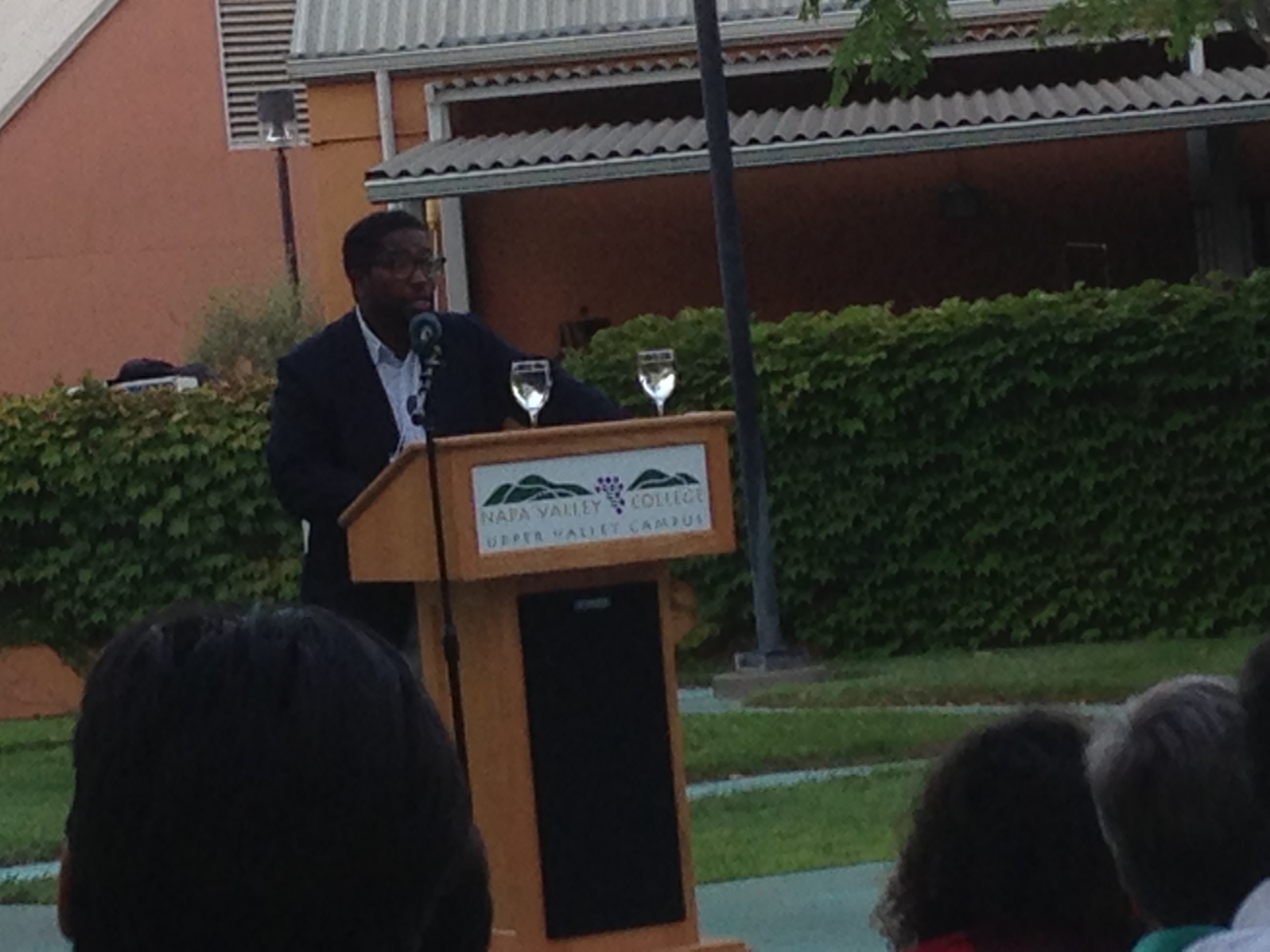
A week ago I was driving home from St. Helena and the community of writers that is the Napa Valley Writers Conference. I was sorry to leave and eager to return home to my family. The drive went quickly with another poet I was dropping at the Oakland Airport. We talked poetry, about our different workshops and then swapped war stories. When we said goodbye at the airport curb he told me he was glad another veteran had been there because he hadn’t been sure how he’d be received. I understood, I hadn’t been sure how I’d be received either, lesbian, feminist, conservatively liberal, retired military war veteran that I am.
Attending this conference was raising the stakes for my identity as a writer and poet. While I have the validation of a Master of Fine Arts degree (in nonfiction), I have not done much work in poetry for oh, several decades. Since February I’ve been on a quest to grow as a poet. Two incidents inspired this choice. Participating with the poetry track of workshops at the San Francisco Writers Conference where I learned from Andy Jones and Brad Henderson of the University of California, Davis, University Writing Program, and Joan Gelfand from the SF Bay Area; poets who are always at the conference and who produced an amazing collection of poetry workshops and events. This year, there was someone new to the conference, Camille T. Dungy. I had an amazing conversation with Camille after one session which led to enjoying lunch together and more conversation. I was inspired to dive deeper into the craft. (In specific, I challenged her on the seemingly ‘inaccessibility’ of contemporary poetry for anyone outside of academia.) Soon after, I was at AWP and catching up with Eloise Healy, I mentioned I was thinking of another MFA, in poetry. Eloise recommended before investing in (going into debt with) another MFA, try some poetry workshops at conferences. I took her advice, which led me to Napa. Where surprise, the scheduled workshop leader for the group I was assigned was unable to attend. Camille T. Dungy was the replacement. Now that’s karma.
Camille gave her students nuggets of craft that I hungrily took and laid in as part of my foundation when crafting or revising work. One of the first was this quote from Elizabeth Bishop, “A metaphor needs to touch in at least three places and two must be in the real world.” This had immediate and profound impact as I created new work and revised previous work. Suddenly, I discovered where detail was vital and in doing so, my words became expansive and immersive where before they had merely been reporting. In the very first craft talk which happened to be delivered by Camille, I gained one of the most important and influential nuggets of the week – Create a pattern, reward the pattern, disrupt the pattern, return to the pattern or as Camille voiced this – Expectation – Reward, Expectation – Reward, Expectation – Expectation – Surprise! Expectation – Reward. This has become the keystone that most affected my development last week and now as I continue to write poetry. This formula can be applied to form, meter, sound, imagery – so many layers.
A true gift of the week was hearing poets and fiction writers read from their work. The poets read first every evening, the fiction writers second. This schedule supportive for the poets, some who
skipped the second reading to scamper back to their rooms and complete the new poem creation that was done daily. (Those slacker fiction writers who concentrated on revision while we poets created a new poem each day;) The poetry readings were vast with depth and emotion and the magic of words come alive. The two that have had the most lasting affect were Linda Gregerson and Camille Dungy. Both delivered their poems with authentic presence, drama, and life. Camille’s poem of the watch over her grandmother as she died and the passing of her namesake over the bed brings tears to my eyes even now as I remember the imagery brought to bear with Camille’s voice in my memory. Linda’s recounting of a young girl’s self harm was dazzling in its courage bringing to bay what is so often hidden by those that cut and denied by those that know of the cutting. The readings were more than just listening to masters display their craft – each reading was itself a master class in bringing words on the page to life in that moment the writer engages audience in physical time and place. We
write in isolation, yet we read and share the product of our inspiration in community.
One of the unexpected chunks of learning I’ve returned home with include alternate workshop methods. Unexpected. I didn’t anticipate learning about how to conduct workshop. I thought I’d adapt to whatever workshop method was used likely based in that prevalent method where the writer is a silent fly on the way (admittedly, a method I despise as disrespectful and often abusive). In Camille’s group, we experienced three distinct workshop techniques, each one respectful of the writing and the writer, each one providing feedback for reinforcement as well as revision. A strong thread throughout the week was internalizing what our peers provided to enhance our own self revision process. Taking the surface value – what a peer says to help improve a piece of writing, then internalizing for a second level of effect to self apply that bit of analysis (not the result but the means) which deepens self capability to look at and determine why and where some aspect of the work needs revision or change. I didn’t expect this drilling into and workshop leader deconstruction of what different aspects of the process of “workshop” provides so that I could internalize the practice. This was certainly not part and parcel of my two years of MFA workshop. Here, I was learning how to write better poems. I was learning how to critique with additional tools. And, I was learning how to not only be a peer in a workshop but tools for when I too, eventually become a workshop leader.
The setting at the St. Helena campus of Napa Valley College was peaceful and enveloping. The surrounding countryside breathtaking. Tuition includes breakfast and lunch created by the resident culinary academy and each meal a treat. Breakfast was amazing with fresh from the nest hard boiled eggs and oatmeal I wish I could cook like that at home. Lunch was a global culinary voyage and while not always what my palate was accustomed to, always worth the journey. I was grateful for the community housing scholarship, placing me in the home of one of the program supporters in the community. Returning each night to my room overlooking the pass between two hills with the vineyard vines blanketing the slopes was rejuvenating. The conference staff running the behind the scenes created a seamless experience. (Shout out to Nan, Iris, and Patrick, and the others whose names I missed.)
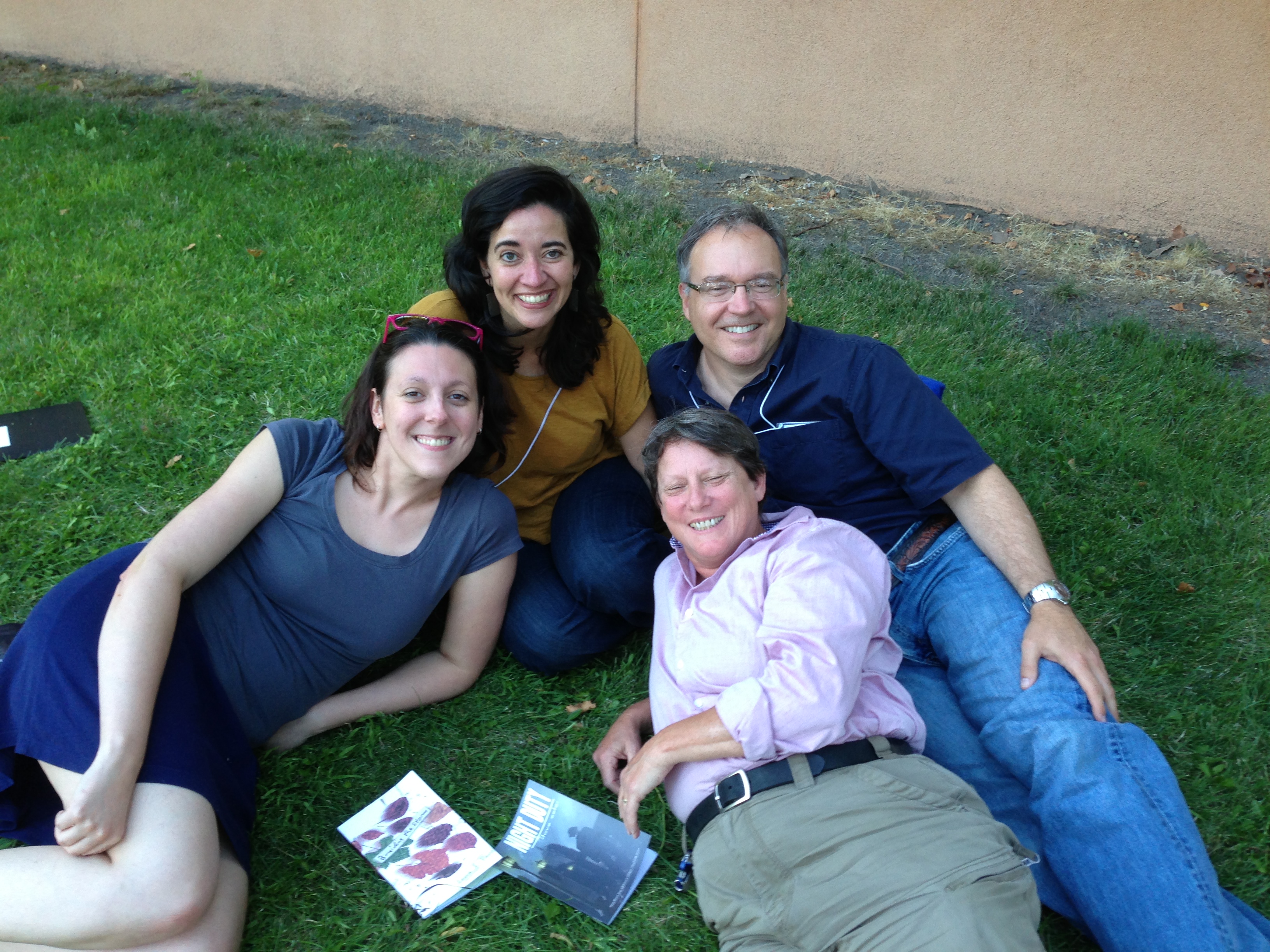
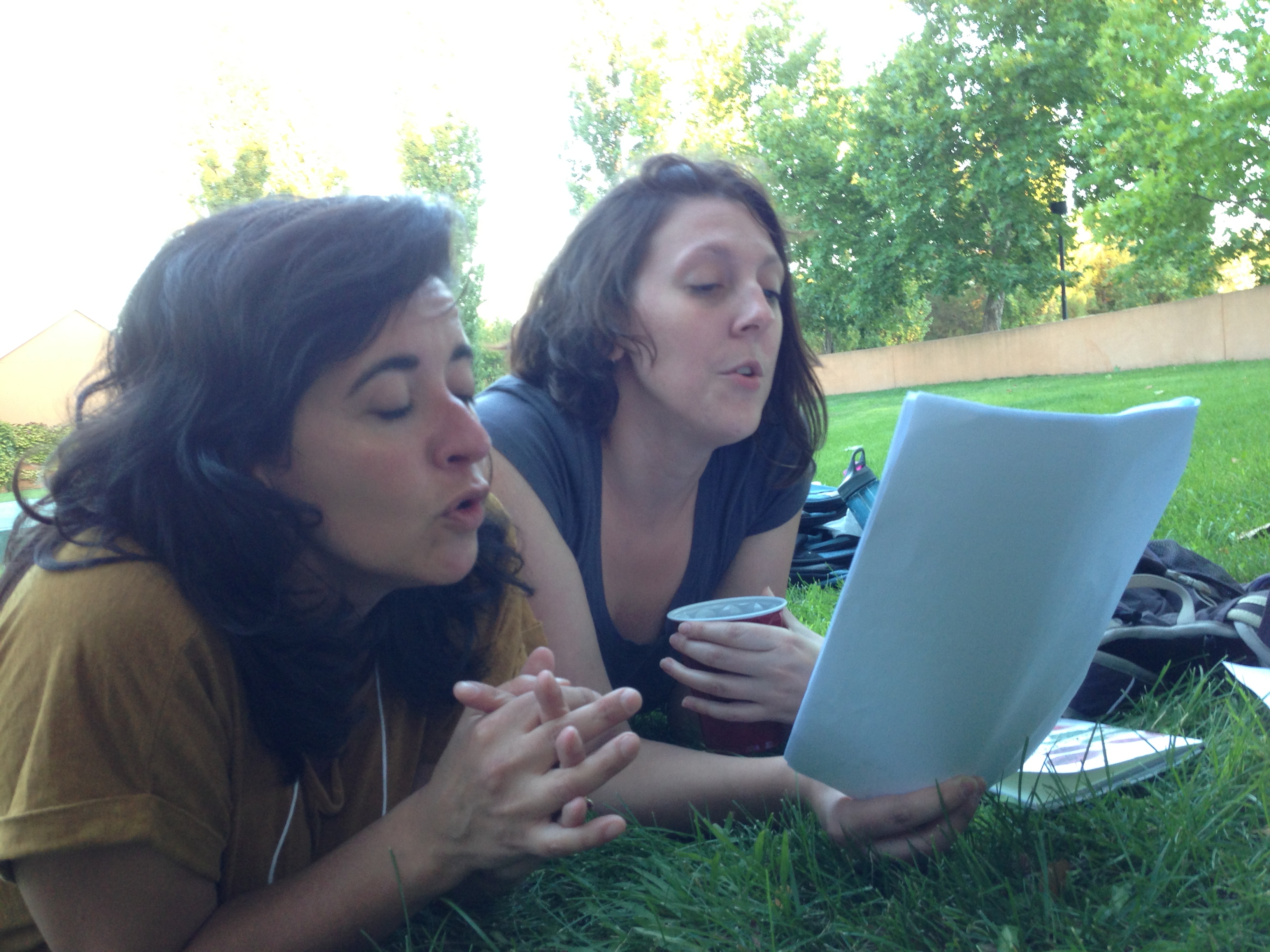
Each day was chock full of opportunity – workshop, poetry and fiction craft talk, a panel discussion (first book, self publishing were two) break for dinner than the nightly reading. Starting at 9 in the morning and ending at almost 9 at night, somewhere in between the poets would produce a new poem for the next morning’s workshop. Midway through the week, I was invited to join a small group of poets gathering to write offsite – this was a huge departure from normality for me. First, it meant giving up my bit of access to the onsite computer lab where I could work and print, which I couldn’t do back at my room (the one disadvantage to community housing – no printing). Second, it would require I be social, more social than workshop participation called for, which as an introvert can be challenging. (Yes, I am so an introvert.) Third, well, I don’t really like working in small groups like that, I’m basically a hermit. I went anyway. And that was my second best decision about the conference I made (the initial being decision to attend in the first place). That little gathering of poets from three different workshops resulted in newly crafted friendships I would not have otherwise formed. On the last evening we stayed long after everyone else left the grounds and had our own little round robin reading (and yes, we all still had work to produce for the final day). We had found our cohort, as one poet exclaimed. And we left the conference with plans to meet up again, serendipity having brought together four poets who all lived close enough to each other to form a new writing group, we now call The Poet’s Cohort.
A highlight of the week was the participant reading on Thursday afternoon. Each reader had two minutes and the timers were brutal calling time. It was a reflection of mutual respect and community cohesion that when the time was called, any reader that was still reading cooperatively stopped. No time enforcement procedures required. There were about 47 poets who read and half that many fiction writers. I truly enjoyed hearing all the different excepts of fiction, a few had me on the edge of my seat – no mean task with only 2 minutes, or about a page worth to read. There was some amazing poetry, some read from published books other from work created in the week. Very few instructors attended, and that was a letdown. Most of the participants were there it seemed, and that was fun.
My week in Napa was a grand investment and indulgence. Indulgence as it meant my full time, works outside the house, wife had to concurrently wrangle our two small children (ages 1 and 4) and we had the financial burden of a week of childcare for the littlest while she was at work. Investment truly as my understanding and application of the craft of poetry is already returning dividends. Since returning home, I’ve submitted to four different markets with six poems and a chapbook out for consideration. I decided to apply for a poetry fellowship next year and the idea of another MFA, this one in poetry, is at the moment off the radar. Eloise was on to something, recommending conference workshops and the opportunity they bring. I’m reading the craft books recommended and written by the workshop leaders, already applying new tools as I craft, create and revise, revise, revise.
I worked hard that conference week. I created four new poems and received useful feedback for revision on a fifth. I was among peers and role models and felt part of the greater community we together formed. In this week since the conference, I felt adrift those first few days, bereft even from the now lost companionship and daily immersion in a small island of words and wordsmiths. I am inspired though, to continue the hard work and looking forward to a return to that bucolic valley and community of writers. Two quotes I’ll close with – you decide where they will take you.
“Interesting writing engages the world around us.” Camille T. Dungy.
Newsletter Signup. Let's trade!
Signup for news, info, and updates. In return, I’ll give you the secret link to Tips from No Red Pen: Writers, Writing Groups & Critique.
Download No Red Pen: Writers, Writing Groups & Critique or the short Ebook Chow (now .99 cents) in the iBookstore, Barns & Noble, Kobo, Diesel, Smashwords and many other Ebook venues. Portions of Chow’s price goes towards development of a Veteran’s MFA Writing Scholarship. Both listed under author name Victoria A Hudson.
Author First Look
First look provides a read of an emerging writer or indie author’s work in progress via a link to their posted first chapter. These are works in progress – so don’t expect perfection. Check the Author’s Bio for how to connect with the writer and if the writer wants feedback or comment. Enjoy the story, essay or poem. Perhaps it will whet your desire for a future book purchase so you can find out what happens next!
Do please comment here on this site, on my facebook page or on Twitter, especially if you enjoy this series once it gets going. Please use hashtag #AuthorFirstLook. Thanks for reading.
Authors retain all rights.
How to get your own first chapter posted:
Your chapter or series of 3-5 poems should be posted on your website. Send an email with the permalink and I will link back to your site. Include your short Bio (no more than about 100 words) and any comment about the work or a series synopsis for posting on First Look Pages. If the book is part of a series, give a spoiler warning if warranted.The link to your site will be embedded in your Bio. If you want reader input, be sure to write that in your comments. Once your book is published, make sure to send me the news and I’ll update your Bio.
Located via the link in the menu at the top of the page. Enjoy your First Look.
Three by Five
Free Literary Magazines aka Recycle Reading
I read a ton of literary magazines. Tossing them in the recycle bin seems so….wrong. Would you like one? Just send me a message on twitter @Vickigeist with snail mail information and I’ll send you one. If so inclined, you can snail a buck or two for the postage. P.O. Box 387, Hayward, CA 94543. You can also just snail a request in if you’d rather with or without that buck or two.

 Welcome back for Part III with Linda Simone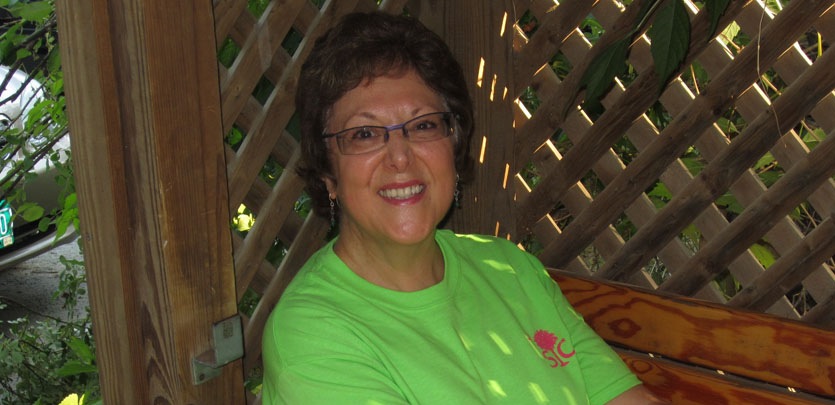









 Vicki Hudson