
 Once away, sometimes we just want to return home to mom, even if just for a little while. From the story Polite Conversation, pages 124-125, the poem Mother was sourced.
Pulitzer Remix is a project of the Found Poetry Review.
Once away, sometimes we just want to return home to mom, even if just for a little while. From the story Polite Conversation, pages 124-125, the poem Mother was sourced.
Pulitzer Remix is a project of the Found Poetry Review.
Filed under writing life
Today’s installment of Found Poetry for the Pulitzer Remix project is entitled Playtime. The source story for this poem was The Hope Chest, pages 116-117 of the The Collected Stores of Jean Stafford.
Just to recap – found poems look at existing text and then remix the words, producing an entirely new work. Consider the source text as a finite pool or bucket of words (resource) and the poet crafting the poem has the task to create something from only the resources at hand.
For my found poems in this project, all words come from the source. The only occasional exception is the title, which sometimes is also drawn from the source text but sometimes, like the poem itself, is a new reflection of the piece.
Pulitzer Remix is a project of the Found Poetry Review.
Filed under writing life
Today’s poem entitled Confession reminds us that destiny is not ours alone. Also sourced from the story Life is No Abyss, pages 106-107.
Filed under writing life
The found Poem Unyielding explores mortality, sourced from pages 94-95 and the story Life is No Abyss.
Filed under writing life
Today’s found poem is entitled Dinner. The story Caveat Emptor is the source text, pages 82-83. Food is such an intimacy when shared.
Filed under writing life
What makes a Well-Rounded Woman is the idea discussed in day four’s remix. Taken from the story Caveat Emptor this found poem looks at what is a woman’s real worth as reflected in culture and society. Pages 76-77 were the source text.
Filed under writing life
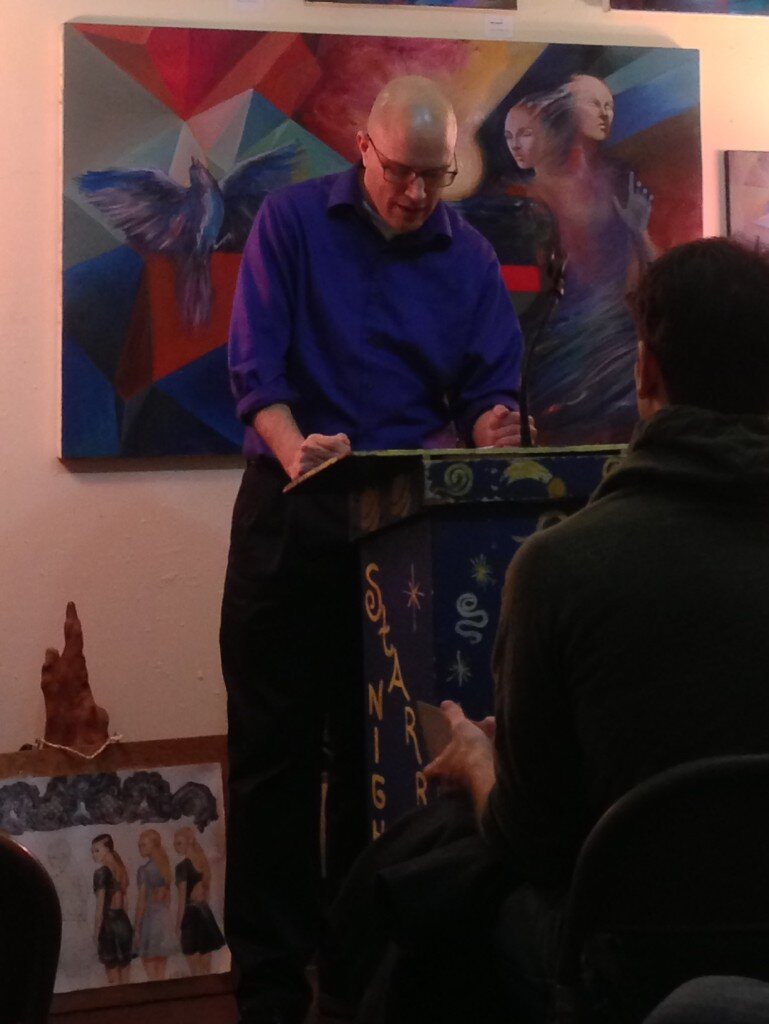 Daniel M. Shapiro is a poet living in Pittsburgh. Due out this summer is his book How the Potato Chip Was Invented (Sunnyoutside Press). He is also the author of a book of collaborative poems with Jessy Randall entitled Interruptions and has authored three chapbooks. Find out more at his web site here.
VAH – I always find the reasons why writers write interesting – Daniel, what are yours?
DAS – I write because I believe daydreaming (or the greatest hits of daydreaming) should be documented. Writing allows you to sit down with ideas that don’t seem to make sense and to turn those ideas into entertainment, art, or a type of consciousness that might not have been articulated previously.
VAH – What was the first piece your wrote?
DAS – I write mostly poems, and my first poem was about springtime. It was titled “Springtime.” Mrs. Picard-Busse, my eighth-grade English teacher, published it without my knowledge in Reflections, the official literary magazine of Twelve Corners Middle School in Rochester, N.Y. I remember it had the line I clutch my umbrella hard. I’m not sure if this is related, but I really can’t stand umbrellas now.
VAH – And your favorite literary character?
DAS – Years ago I would’ve said R.P. McMurphy from One Flew Over the Cuckoo’s Nest because I worshiped that book, but more recently I’ve been reading to my kids, especially the Harry Potter series. I was always fascinated by Professor Snape and knew he would play a role in some sort of twist at the end of the series. I believed in Snape. I thought he was the most complete character. I am drawn to misunderstood characters whose truths are revealed gradually.
VAH – If you were stranded on a deserted island, what book or books would you want stranded with you?
DAS – The practical answer is Yukio Mishima’s Sea of Fertility tetralogy. I love his writing so much and have let those books sit on my shelf for years. Confessions of a Mask was what Catcher in the Rye would’ve been if Holden Caulfield had been a gay Japanese teenager. I’ve never been gay or Japanese, but I identified more strongly with the character in Confessions than I did with Holden. Anyhow, if the Sea of Fertility books were all I had, I would finally be forced to read them and would enjoy doing so.
VAH – And your biggest influence in your development as a writer?
DAS – I can think of two main influences: A.) Playwrights (Ionesco, Pinter, Mamet, et. al.) introduced to me by my high school English teacher Dr. Gary Wiener. After I told him how much I liked Waiting for Godot, Dr. Wiener pointed me toward other absurdest writing that wasn’t part of the curriculum. B.) Friends who write well. One of my best friends for the last 30+ years, Jessy Randall, has been writing poetry since before I knew her. Also, many people whom I’ve met first over the Internet and then in person (Matt Hart, Maria Chelko, Carol Guess, and others) continue to inspire me with their work and overall generosity. I am especially drawn to highly specific writing, e.g., poems that provide insight via the poet’s distinct individuality.
Filed under writing life
The story A Modest Proposal provides the source text for the next installment, Pan was found using pages 68-69. This found poem reflects upon isolation, infertility and drive for survival.
Filed under writing life
The second remix is from pages 56-57, the short story The Maiden.
Using three stanzas of six lines, ten lines, then six lines again; this found poem entitled Femininity is an ode to the definition of womanhood and femininity, or perhaps a discussion from different perspectives.
Filed under writing life
The first poem from The Collected Stories of Jean Stafford was sourced from the first section of the Table of Contents. This first poem is entitled Advice to a Young Woman.
This post used 22 words as the pool for source text, with five being the word ‘the’, thus reducing the selection to 18 words. Using homonyms, the resultant found poem provides a bit of advice for someone.
Filed under writing life




 Vicki Hudson